Women's History · Books
The Treasure of the City of Ladies
Original titleLe trésor de la cité des dames de degré en degré et de tous estatz
Christine de Pizan’s 1405 French work addresses women across social ranks, linking learning and counsel to household and political power while preserving medieval hierarchies.
Review and reading guide
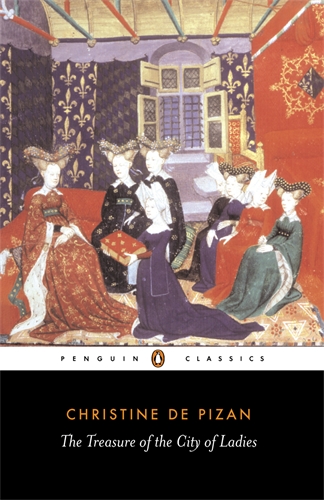
The cover and bibliographic fields identify the Penguin Classics edition translated by Sarah Lawson, published in 2003 (ISBN 9780140449501). The original work dates to 1405.
Christine de Pizan completed The Treasure of the City of Ladies, also known as The Book of the Three Virtues, in 1405. Often read as a sequel to The Book of the City of Ladies, it shifts from an allegorical city built out of women’s histories to a work of instruction arranged around women’s circumstances and social rank. The French National Centre for Scientific Research’s Jonas catalogue dates its composition from spring to 7 November 1405 and identifies its language as French d’oïl; the British Library catalogues it as an educational treatise for women under both title forms.
The book has three parts and 53 chapters. The first addresses queens, princesses, and noblewomen, treating faith and marriage alongside widowhood, the care of heirs, mediation between a ruler and his barons, court management, income, and finance. The second turns to women at court, noblewomen outside it, and women in religious life. The third extends the discussion to merchants’ households, widows, girls and older women, women in trades, servants, agricultural households, and poverty. This structure matters because it treats women’s instruction as knowledge connected to household administration, economic survival, and public order—not only as private refinement. Yet the sequence is an author’s map of women’s estates, not a record in which women from each group speak for themselves.
Advice to elite women carries a political argument. Pizan does not present a princess as powerless: she is expected to manage resources, sustain relations at court, care for heirs, and help maintain peace between ruler and subjects. In one striking passage, a voice of temptation urges a princess to amass wealth so she can take revenge and enjoy luxury. The Virtues answer that unjust wealth is gathered at other people’s expense and that rank brings obligations rather than a license for private appetite. The language is Christian and moralizing, but the passage also makes authority accountable. A woman who governs a household or influences a court is not merely being told how to appear; she is being asked how power should be used.
The phrase “from rank to rank” marks both an expansion and a boundary. The work explicitly includes women who sell, make, serve, farm, and live in poverty. But these figures mostly appear as categories to be advised by a learned author, not as narrators of their own labor. Across the chapters, Pizan emphasizes reputation, sexual conduct, clothing, marital duties, and behavior appropriate to one’s station. One section cautions women in towns against dress that crosses the clothing distinctions assigned to their rank. The text does not propose modern social equality, dismantle estate hierarchy, or free women from Christian norms. Its invitation to women of many positions should not be mistaken for equal authority or equal access to learning.
That tension is where the book becomes most useful to feminist reading. Pizan claims the intellectual authority to address women from the highest court to households far below it, and makes women’s judgment, education, and management part of the political community. At the same time, her defense works within the social and religious structures of her own world; it disciplines as well as equips. Rather than choosing between calling her either a feminist “ahead of her time” or a conservative moralist, readers can ask how an unusually authoritative woman writer made arguments for women’s competence through the available language of virtue, rank, and Christian duty—and which women that framework still left unheard.
Project Gutenberg offers a French-language reading text transcribed from images supplied by the Bibliothèque nationale de France / Gallica; it is not a modern English translation. A useful first route is to read the prologue and contents, then compare the chapters on court finance and mediation with those addressed to merchants, women in trades, servants, and poor households. Notice where the advice changes with social position, and where the same demands for reputation and restraint recur. Pair the text with an article on modern feminist artists reimagining The City of Ladies. That article is about Pizan’s earlier work and its artistic afterlives, not a direct study of this sequel; read together, the two works place the imagined construction of a women’s city beside the regulation and governance of women’s everyday lives.
Text and catalogues: Project Gutenberg French text and formats; IRHT-CNRS text record; British Library manuscript catalogue.


Explore another medium
- Articles
City of Ladies: Modern Artists Are Redefining a 15th-Century Call to Arms by an Early French Feminist
Charlotte Cooper-Davis
Oxford scholar Charlotte Cooper-Davis follows The City of Ladies into contemporary installation and performance, raising a further question: whose bodies and memories can shape an imagined city?
Women's History · Historical Context - Articles
Histories of the Self: Women's Diaries in Heian Japan
Sonja Arntzen
Sonja Arntzen reads three Heian women's diaries through poetry, marriage, court labor, and reading, showing how literary form shaped self-writing while exposing questions of class and representation.
Women's History · Women's Literature
Continue through the issues
Related theme · No. 08
Who sustains a revolution?
Beginning with a woman searching for her husband in Sambizanga, we follow the messages, care and organizing that sustain resistance. Across anticolonial struggle, labor and solidarity, who carries a revolution’s daily work—and who is left outside its promise of liberation?
Political Participation
Related theme · No. 10
Whose voices are heard?
From a room to write in to diaries, testimony and film, this issue follows how women’s experiences become knowledge and history, and who controls publishing, archives and public debate. Speaking requires time, resources and listeners, as well as power over interpretation and circulation. Across creative work, collective knowledge, historical records and media responsibility, we examine the distance between speaking and being heard.
Women's Writing
Reader responses
Readers' notes
Share your reading or add a thread worth following further.
Join the Discussion
Loading comments...
Support Us
If you find our content valuable, please consider supporting FemRes.