Body Politics · Books
The Vegetarian
Original title채식주의자
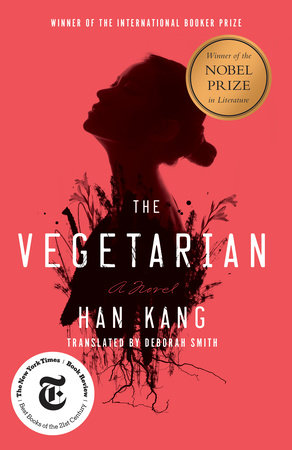
The Vegetarian is a Man Booker International Prize-winning novel by Korean author Han Kang. It tells the story of Yeong-hye, an ordinary housewife who, in order to reject human violence, decides to stop eating meat and eventually wants to transform herself into a tree. It is a fable about female bodily autonomy, refusal of social norms, and the quest for a purely 'harmless' existence in a violent world.
Review and reading guide
Han Kang’s novel, first published in Korea in 2007, became internationally visible after Deborah Smith’s English translation won the 2016 International Booker Prize. Its three linked parts shift among the perspectives of Yeong-hye’s husband, brother-in-law, and sister; Yeong-hye herself is often encountered through other people’s accounts and through dreams (publisher description; Han Kang’s Nobel biography). That form matters to a feminist reading: the book makes violence against a woman’s body visible while withholding the comfort of a single, fully authoritative explanation of her refusal.
Yeong-hye’s refusal first reaches the reader through her husband’s account. Before readers hear much of her own explanation, she has already become an object of other people’s judgment and naming. That narrative distance matters: her actions unsettle household roles, but the novel never gives her a stable explanatory voice that would let family or reader settle their meaning.
“The Vegetarian” employs a unique three-part structure, with each section narrated by different male narrators while Young-hye’s own voice remains consistently marginalized. The first part, “The Vegetarian,” is told by Young-hye’s husband; the second part, “Mongolian Mark,” is narrated by her brother-in-law; the third part, “Flaming Trees,” is told by her sister (although the sister is female, she has largely internalized patriarchal values). This narrative strategy itself serves as a profound metaphor for women’s circumstances. Young-hye, as the central character of the story, cannot directly tell her own story—her experiences and feelings are always filtered and interpreted through others’ perspectives. This “voiceless” state accurately reflects women’s circumstances in patriarchal society: their bodies and lives are defined, explained, and controlled by others. The three narrators represent different facets of patriarchal society: the husband represents everyday gender oppression, the brother-in-law represents artisticized male gaze and desire projection, and the sister represents female collaborators who have internalized patriarchal values. Through these three perspectives, Han Kang comprehensively demonstrates women’s predicament within patriarchal networks. Each narrator’s perspective reveals different aspects of how patriarchal systems operate through seemingly ordinary relationships and interactions, showing how women’s experiences are mediated, distorted, and appropriated by others rather than being allowed authentic expression.
Yeong-hye’s refusal begins with disturbing dreams and becomes a domestic conflict when her husband and family try to make her eat. The dinner scenes can be read as contests over who has authority to define acceptable conduct, but they do not license a general claim that Korean culture is uniformly collectivist or obedient. Nor does the text establish vegetarianism as a coherent political program: Yeong-hye gives little explanatory speech, while the people around her supply motives and meanings. The feminist force lies partly in that imbalance—her bodily refusal is unmistakable, yet its interpretation is contested. A peer-reviewed study similarly attends to the novel’s shifting perspectives and the relation between bodily harm, care, and nonhuman life (“Interrogating ‘Feeling Politics’”).
One of “The Vegetarian’s” most shocking themes is the female body as a site of social control. Young-hye’s body becomes a battlefield for various power struggles: her husband demands she fulfill her “duties” as a wife, her father forces her to eat meat to maintain family face, her brother-in-law aestheticizes and eroticizes her body. One of the most violent scenes in the novel is when Young-hye’s family forces her to eat meat. Her father grabs her jaw and tries to stuff meat into her mouth—this scene’s violence lies not only in physical coercion but in what it symbolizes: patriarchy’s complete negation of women’s will. The female body doesn’t belong to herself but is property of family and society. Young-hye’s response to this violence is even more extreme self-destruction: she slashes her wrists in suicide attempt and later refuses all food, trying to become a tree. This self-destructive behavior paradoxically becomes the only way she can control her own body. Unable to gain bodily autonomy, destroying the body becomes final resistance. The novel’s treatment of bodily autonomy extends beyond individual choice to encompass broader questions about who has the right to make decisions about women’s bodies and how social institutions enforce compliance with gender norms through control over women’s physical existence.
In the later parts, Yeong-hye imagines herself as a tree, turning her body upside down and believing that sunlight might sustain her. The fantasy offers an image of existence outside eating and human demands, but the novel never makes plants a simple, peaceful alternative or her wish a successful route to freedom. Her body deteriorates; her sister’s efforts to keep her alive become a second, anguished perspective on care, consent, and the limits of interpretation. The plant imagery can therefore register both refusal and danger. Rather than declare complete autonomy impossible, Han Kang leaves readers with a harder question: what does care mean when the person’s expressed will and immediate survival appear to conflict?
In the novel’s second part, Young-hye’s brother-in-law is an artist who uses Young-hye’s body as artistic creation object, painting flowers all over her and having sexual relations with her. This plot explores complex relationships between art, desire, and exploitation. The brother-in-law beautifies his behavior as artistic creation, but this is actually another form of objectification and exploitation. His fascination with Young-hye is not understanding and respect for her as a person but using her as a tool to satisfy his artistic fantasies and sexual desires. Artistic justification cannot conceal exploitative essence. This plot also critiques the tradition of male artists’ aestheticization of female bodies. In art history, female bodies have often served as objects of beauty and sources of inspiration, but women’s voices as creative subjects are often ignored. Through this plot, Han Kang questions gender power relationships within this artistic tradition. The artistic exploitation represents broader patterns of how women’s pain and resistance are appropriated and aestheticized by others rather than being understood on their own terms or leading to meaningful support for women’s liberation.
In the final section, Yeong-hye is hospitalized as her refusal of food and wish to live as a plant become physically life-threatening. Her refusal interrupts others’ claims over her body, yet its bodily cost and the narrowing of her capacity to speak keep it from becoming a simple liberation story. In-hye’s effort to keep her alive is not reducible to institutional discipline; it is painful care caught between taking her sister’s will seriously and responding to imminent danger. Han Kang leaves that ethical conflict unresolved.
In-hye is not merely a figure who has “succeeded” through conformity. As caregiver, she must sustain her sister’s life while understanding her only partially, and confront their shared family history. Her labor makes care appear morally necessary and physically exhausting—not a simple opposite to Yeong-hye’s refusal. A study of shifting perspective and care offers one route into this relation (“Interrogating ‘Feeling Politics’”).
The family authority in the novel operates in a specific contemporary Korean setting, but the book should not be treated as a key to Korean culture as a whole. Pressure takes shape through family expectations, marriage, food, and medical institutions. This lets readers examine those mechanisms without attributing them to a single “collectivist” or “obedient” culture; contextual precision makes comparison more responsible.
The Vegetarian appeared in Korea in 2007; Deborah Smith’s English translation won the 2016 International Booker Prize. This records how translation brought the novel to a wider readership, but it does not reduce its circulation to one translator or establish a single international feminist reading. Han Kang’s 2024 Nobel Prize offers another point of entry for new readers, while the novel’s complexity still asks for attention to its shifting perspectives and form (publisher; Nobel biography).
This is not an empowerment fable that moves from resistance to victory. Yeong-hye’s refusal interrupts others’ authority over her body, while bodily decline narrows her space for living; the novel offers no easily copied model of “successful resistance.” Its force lies in holding refusal, harm, and care together without making any one of them a complete resolution.
The plant imagery also invites an ecofeminist reading, but it is not a settled ecological program. Yeong-hye’s desire grows from recurring dreams and her refusal of meat. Becoming a plant suggests existence beyond human-centered order, yet her physical collapse cannot be romanticized as harmony with nature. The novel preserves both the attraction and the danger of that image.
Reading the novel alongside current discussions of bodily autonomy, gendered violence, and medical authority can be illuminating, but it is not a prophecy of later movements or a political manifesto. A closer reading follows who gets to watch, interpret, and care for Yeong-hye—and when those acts become forms of control.
Useful companion scholarship includes feminist care ethics and animal ethics, as well as work on translation and literary prestige. Danielle Sands examines how the novel connects interspecies empathy with animality and vegetality, while emphasizing that escape into plant subjectivity remains unresolved; Dominic O’Key places its feminist and ecofeminist readings beside its translation and International Booker circulation, asking how an affirmative politics is folded into world-literary prestige (Sands; O’Key). Read together, these approaches keep bodily refusal, care, relations across species, and publication context in view without making any one a final answer.


Explore another medium
- Films
The Substance
Coralie Fargeat
A body horror film directed by Coralie Fargeat, starring Demi Moore and Margaret Qualley. Following washed-up actress Elisabeth who, after being fired due to ageism, uses a mysterious drug to create a younger, perfect version of herself. Through extreme body horror aesthetics, the film deeply explores crucial issues including ageism, beauty standards, body politics, female self-hatred, and patriarchal control over women's bodies, becoming a representative work of contemporary feminist horror cinema.
Body Politics · Mental Health - Podcasts
Masala Podcast: The South Asian feminist podcast
Sangeeta Pillai / Soul Sutras
Masala Podcast is hosted by Sangeeta Pillai, an award-winning South Asian feminist podcast focusing on sex, body, mental health, and cultural taboos. The show features intimate narrative and critical reflection, exploring themes of shame, sexual harassment, menopause, belonging, and motherhood pressure, emphasizing diverse experiences of South Asian women and intersectional feminist perspectives.
Body Politics · Mental Health
Continue through the issues
Related theme · No. 03
Who gets to define the body?
From discipline and ageing to the internalised gaze, this issue follows the forces that watch, name and reclaim the body.
Body Politics
Related theme · No. 08
Who sustains a revolution?
Beginning with a woman searching for her husband in Sambizanga, we follow the messages, care and organizing that sustain resistance. Across anticolonial struggle, labor and solidarity, who carries a revolution’s daily work—and who is left outside its promise of liberation?
Social Resistance
Reader responses
Readers' notes
Share your reading or add a thread worth following further.
Join the Discussion
Loading comments...
Support Us
If you find our content valuable, please consider supporting FemRes.