Who defined the category?
Treat labels such as risk, gender, merit and normality as decisions with histories, not as natural properties discovered by a model.
Explore curated feminist content about Data Feminism
FemRes guide
Data feminism begins before a spreadsheet is opened or a model is trained. It asks who had the authority to define the problem, create the categories, collect the evidence and decide what would remain uncounted. Data do not simply describe a world already there. Budgets, institutions and inherited classifications make some lives highly legible while leaving other work, harms and identities absent, distorted or exposed only to systems of control.
A missing record can signal neglect: medicine built around male bodies, economic measures that erase unpaid care, or public systems that fail to document violence against marginalized people. But the answer is not always more collection. The same communities denied recognition may also be overmeasured by police, welfare agencies, borders and platforms. Data justice must distinguish the right to be counted from the right not to be captured, and public accountability from extraction disguised as inclusion.
Algorithmic bias is therefore not merely a defective sample awaiting technical repair. Search rankings, facial analysis, risk scores and automated eligibility systems operate inside racialized and gendered institutions. Improving accuracy can distribute an existing institution's decisions more evenly without making those decisions legitimate. Intersectional analysis asks where aggregate categories conceal concentrated harm; situated knowledge asks whose experience can challenge an official model; design justice asks whether affected people can set purposes, control resources and refuse deployment.
The archive also makes the labor and materiality of data visible. Annotation, moderation, maintenance, community documentation, mineral extraction and energy use sit beneath interfaces described as frictionless or intelligent. A feminist approach joins representation to political economy: who is pictured, who works, who owns the infrastructure, who absorbs error and environmental cost, and who can demand repair. Its goal is not a perfectly neutral dataset, but democratic power over what is measured, built and allowed to govern life.
Treat labels such as risk, gender, merit and normality as decisions with histories, not as natural properties discovered by a model.
Missing data may reveal neglect, but it may also protect people from surveillance. Ask who wants collection and who bears its risks.
A model can classify every group equally well while strengthening an institution whose purpose, remedy or coercive power remains unjust.
Participation matters only when communities can alter categories, budgets, ownership, deployment and the option to refuse.
Move from visible examples of bias to intersectional auditing and co-design, then trace data systems through labor, welfare, infrastructure and institutional power.
15 minutes
Start with workplace AI bias, then see how visualization choices organize authority, uncertainty, embodiment and attention.
One hour
Connect commercial search, intersectional accuracy testing and community-led design to see why diagnosis must lead to redistributed authority.
Deep study
Build a feminist method, then trace extraction, automated public services and racialized classification from infrastructure to everyday consequence.
Adjacent topics
13 · Data Feminism

Books · Mar 2023
A powerful work by NYU professor, data scientist, and one of the few Black women AI researchers, Meredith Broussard. Reveals how tech neutrality is a myth and algorithms need accountability. From facial recognition only trained on lighter skin tones, to mortgage algorithms encouraging discriminatory lending, to dangerous feedback loops in medical diagnostic algorithms. Solution isn't making omnipresent tech more inclusive, but rooting out algorithms that target demographics as ‘other.’
02
Books · Aug 2022
Kate Crawford maps AI through minerals, energy, hidden labor, training data, classification, and state surveillance, revealing the extraction and concentrated power beneath machine intelligence.
03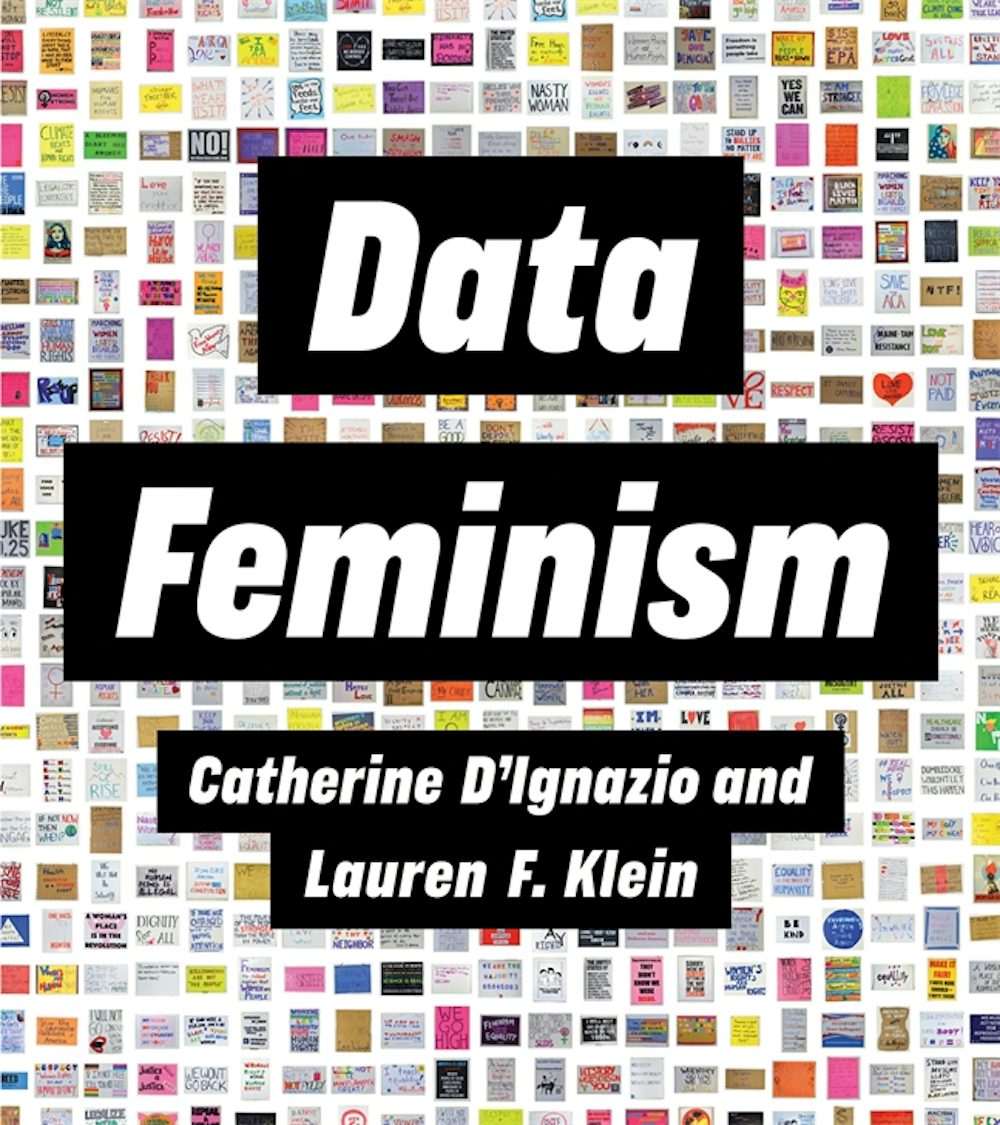
Books · Mar 2020
It proposes seven practical principles that bring power analysis, intersectionality, situated knowledge, and co-design into data work itself.
04
Books · Mar 2020
Starting from trans airport screening and disability justice, Sasha Costanza-Chock argues for design led by affected communities, placing benefit, ownership, and accountability above expert good intentions.
05
Books · Jul 2019
Ruha Benjamin’s New Jim Code framework shows how racial hierarchy can be engineered, hidden by defaults, intensified through surveillance, or repackaged as a benevolent technical fix.
06
Books · Mar 2019
A shocking exposé into how the world is designed for men as the 'default,' systematically ignoring women's data. Spanning healthcare, technology, urban planning, and economics, Caroline Criado Perez reveals how invisible data bias seriously impacts women's health, safety, and lives.
Articles · Jun 2024
UN Women connects biased AI outputs with the data, institutions and decisions that shape technology.
02Articles · Jan 2019
The Feminist Data Manifest-No pairs refusal with commitment, asking how data attaches to bodies, reproduces inequality and whether people can meaningfully say no.
Papers · Jun 2024
Klein and D’Ignazio bring data feminism into AI research, using tenant screening, feminist data activism, and hidden annotation labor to examine power, consent, and environmental costs.
02Papers · Feb 2018
Buolamwini and Gebru audit commercial gender classifiers, showing how overall accuracy conceals unequal errors across skin-type and gender groups.
03Papers · Oct 2016
D’Ignazio and Klein turn feminist epistemology into questions for visualization design: how categories, visual form, participation, context, and labor shape whose knowledge becomes legible.