Latina Feminism · Books
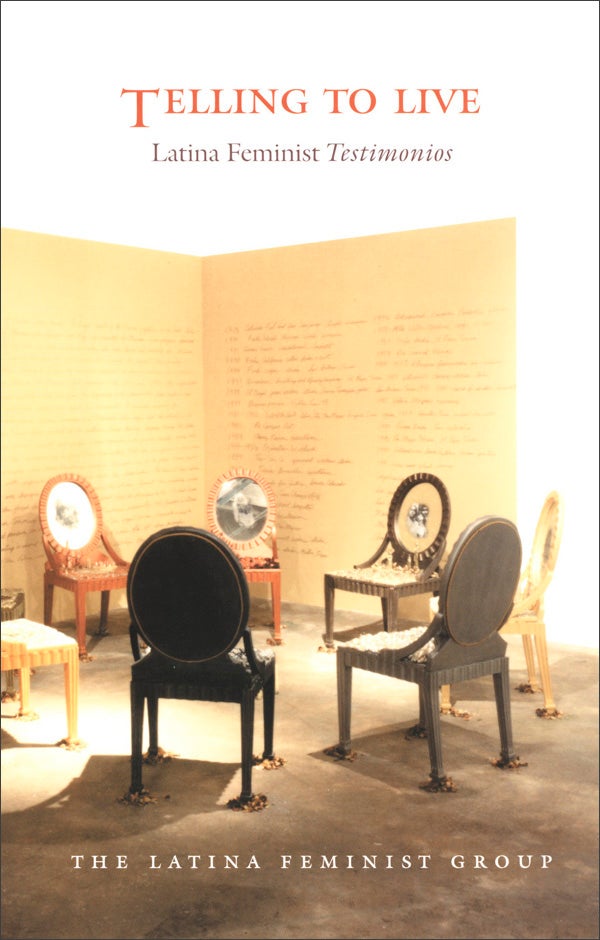
Telling to Live: Latina Feminist Testimonios
A Latina feminist collective uses testimonios to connect life stories, academic institutions and collaborative knowledge without erasing differences.
Review and reading guide
Telling to Live: Latina Feminist Testimonios is a collective work about how a life story can become feminist knowledge without being made to stand for every life like it. The Latina Feminist Group brings together eighteen contributors whose backgrounds include Puerto Rican, Chicana, Mexican, Cuban, Dominican, Sephardic, Native, Central American, and mixed-heritage locations. The publisher describes them as poets, oral historians, literary scholars, ethnographers, and psychologists who share an investment in producing knowledge through experience. That combination matters: these are not stories added to scholarship after its concepts have already been settled. The narrators ask what counts as evidence, who is recognized as an intellectual, and what kinds of labor make a life legible to an institution.
The book’s four-part structure—“Genealogies of Empowerment,” “Alchemies of Erasure,” “The Body Re/members,” and “Passion, Desires, and Celebrations”—moves among education, memory, embodiment, work, intimacy, and pleasure. The table of contents places titles such as “You Speak Spanish Because You Are Jewish?,” “Welcome to the Ivory Tower,” “Reading the Body,” and “Shameless Desire” within one volume. Read together, that arrangement resists the familiar split between public politics and private experience: a name, a family story, a bodily memory, or a desire can reveal how race, language, class, sexuality, and institutional authority are organized. The collection does not need to turn every contributor into an example of one theory; its form lets distinct accounts alter the questions readers bring to theory.
The introduction also describes a methodological turn. The group initially set out to conduct collaborative comparative research on Latina issues, then found that conventional comparison risked compressing complex lives into variables. They made their own trajectories part of the inquiry instead, developing the project through seven years of meetings, narration, and discussion. This was not a refusal of analysis; it was a question about who analyzes, how categories are made, and whether researchers can also become producers of knowledge about their own lives. Testimonio therefore names both a form of telling and a way to renegotiate power among researchers, narrators, and audiences.
The term testimonio is useful here when understood as a situated act of witnessing and address, not as a transparent transcript of an untouched self. A life is told to someone, in a language and genre, under conditions that shape what can be said and believed. The contributors’ professional work makes that problem especially sharp. Higher education may offer tools and an audience, yet it also sets standards for “proper” speech, individual authorship, and detached expertise. The volume’s collective authorship and mixture of memoir, poetry, dialogue, and reflection make those standards visible rather than neutral. They ask readers to notice the labor of translation between lived experience and academic recognition—and who is expected to perform it.
Coalition is therefore a practice, not a claim that differences have disappeared. The publisher’s account stresses varied racial, national, linguistic, religious, sexual, and class backgrounds; the contents also refuse to reduce those histories to one seamless Latina identity. A shared political project can create room for solidarity while leaving disagreement and unequal institutional position in view. This is a demanding model: difference cannot be flattened into a universal “women’s experience,” but neither should it become a reason to stop listening or to evade obligations to one another. The book’s intellectual contribution lies in holding that tension open as part of how feminist knowledge is made.
A further methodological point emerges from the collection’s mixture of forms. A poem, a family vignette, a dialogue, and an account of academic work do not make identical claims, and forcing them into one polished autobiographical arc would erase that difference. Their coexistence asks institutions to expand what they can recognize as knowledge, rather than asking every narrator to translate herself into the same credentialed voice. In this sense, inclusion is not the final goal: the standards by which experience becomes credible are themselves part of the subject.
Its scope is also specific. This is an intergenerational anthology of women negotiating U.S. society and higher education around the turn of the twenty-first century, not a complete account of Latina life, Indigenous women’s histories, or Latin American feminisms. “Latina” can connect political and cultural histories, but it can also conceal differences of race, migration, language, nation, and relation to colonial power. For readers, the volume is strongest when placed beside other projects that make the conditions of feminist authorship explicit: Making Face, Making Soul/Haciendo Caras brings together art, literature, and criticism across difference, while This Bridge We Call Home revisits coalition as an unfinished, changing practice. These are companion routes, not interchangeable accounts.


Reader responses
Readers' notes
Share your reading or add a thread worth following further.
Join the Discussion
Loading comments...
Support Us
If you find our content valuable, please consider supporting FemRes.