Feminist Fiction · Books
The Women's Room
Marilyn French's bestselling 1977 novel follows Mira Ward from postwar marriage and unpaid domestic work back to Harvard, asking how economic dependence, women's solidarity, sexual violence, and race shape feminist freedom.
Review and reading guide
Published in 1977, Marilyn French’s The Women’s Room became one of the most widely read feminist novels of its era. Its central figure, Mira Ward, moves from a 1950s suburban marriage toward feminist consciousness and a return to graduate study. The novel is best read not as a sociological portrait of every woman, but as an ambitious account of a particular generation’s bargain: education and independence are surrendered for marriage, then painfully reclaimed when that arrangement fails.
Mira has set aside her own education to support Norm, a medical student who becomes her husband. Years of childcare, housework, and emotional accommodation make his professional future possible while narrowing hers. When the marriage ends, Mira returns to Harvard graduate school in her late thirties. That return is more than a story of personal resilience: it exposes how an intimate division of labor distributes money, time, credentials, and the capacity to imagine a future. Leaving a marriage may open a door, but it does not by itself repay the years of unpaid work or remove the economic structures that made dependence seem normal.
The women Mira meets help turn private dissatisfaction into shared analysis. Their conversations resemble consciousness-raising: experiences once treated as personal inadequacy become recognizable patterns of gendered expectation and power. The title’s “women’s room” points first to the ordinary women’s restroom, not a ready-made refuge; the novel enlarges that small, segregated space into an idea of women speaking with one another beyond the roles assigned to them. Yet the group is not a frictionless sisterhood. Its members differ in temperament, politics, sexuality, and strategy, and their disagreements show that solidarity is something to make, not proof that all women want the same thing.
French gives the novel a forceful political voice through characters such as Val, whose radical feminism refuses the promise that accommodation alone will make women safe. The book places sexual violence within the landscape of ordinary male power rather than treating it as an isolated aberration. Near its close, the response to a young Black woman’s rape links gendered violence to police power and to the risks of public organizing; Val’s death makes the cost of that intervention impossible to sentimentalize. Read together, these events ask how violence travels from intimate relations into institutions—and what it means to act collectively when the state itself can become a source of danger.
That political force also carries limits worth facing. The novel’s principal lens remains that of white, heterosexual, middle-class women in the United States. Its deliberately sweeping anger can make men appear as a single type and can turn a character’s rhetoric into an apparent statement about all women or all men. The young Black woman near the end risks becoming the occasion for a white character’s political story rather than a fully centered subject in her own right. These tensions do not cancel the novel’s historical importance; they show why its account of liberation must be read alongside Black feminist criticism and histories that question whose experiences second-wave narratives made representative.
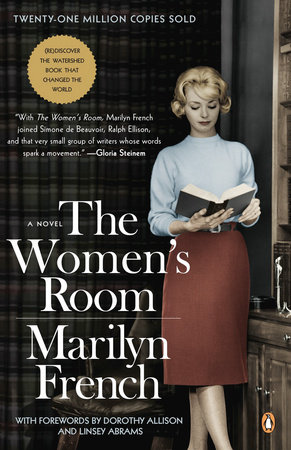
The novel’s scale and polemical style helped it travel far beyond literary circles: the publisher describes it as a bestselling feminist classic, with more than twenty-one million copies sold. Its achievement is not that it supplies a timeless theory of gender, but that it gives narrative form to how social arrangements are lived—in the body, the household, the classroom, friendship, and political action. Its sharper passages remain provocative, while its exclusions make it a useful text for asking how a movement can expose one hierarchy and still reproduce another.
Read The Women’s Room as a historical novel whose questions outlast its setting. Ask what makes Mira’s education and independence materially possible, whose labor supports them, and whose account of violence receives narrative space. Then compare its picture of marriage with Adrienne Rich’s Of Woman Born: Motherhood as Experience and Institution: Rich distinguishes lived mothering from the social institution that organizes and controls it, offering a different lens on the domestic bargain French dramatizes. The comparison makes clear that feminist freedom is not simply escape from the home; it also requires changing the conditions that decide who performs care, who has choices, and whose future counts.


Explore another medium
- Films
Happy Hour
Ryusuke Hamaguchi
Over five hours and seventeen minutes, Ryusuke Hamaguchi follows four women approaching forty in Kobe as friendship, marriage, work and departure test what it takes to speak honestly and truly hear one another.
Marriage Critique · Identity and Selfhood - Films
Cléo from 5 to 7
Agnès Varda
Across ninety minutes in Paris, Varda turns a singer’s fear into a question of looking, listening and living with uncertainty beyond the demand to remain beautiful.
Identity and Selfhood · Female Friendship
Continue through the issues
Included in · No. 04
Are we really listening to one another?
Across friendship, strained marriages, care, desire and departure, this issue treats intimacy as a political field: who has room to speak, whose silence is misread, and who is never heard.
Marriage Critique · Identity and Selfhood
Included in · No. 02
Who gets to say who we are?
From gender identity to diaspora and migration, this issue asks how identities are assigned, contested, and rewritten on our own terms.
Identity and Selfhood
Reader responses
Readers' notes
Share your reading or add a thread worth following further.
Join the Discussion
Loading comments...
Support Us
If you find our content valuable, please consider supporting FemRes.