Digital Feminism · Screen
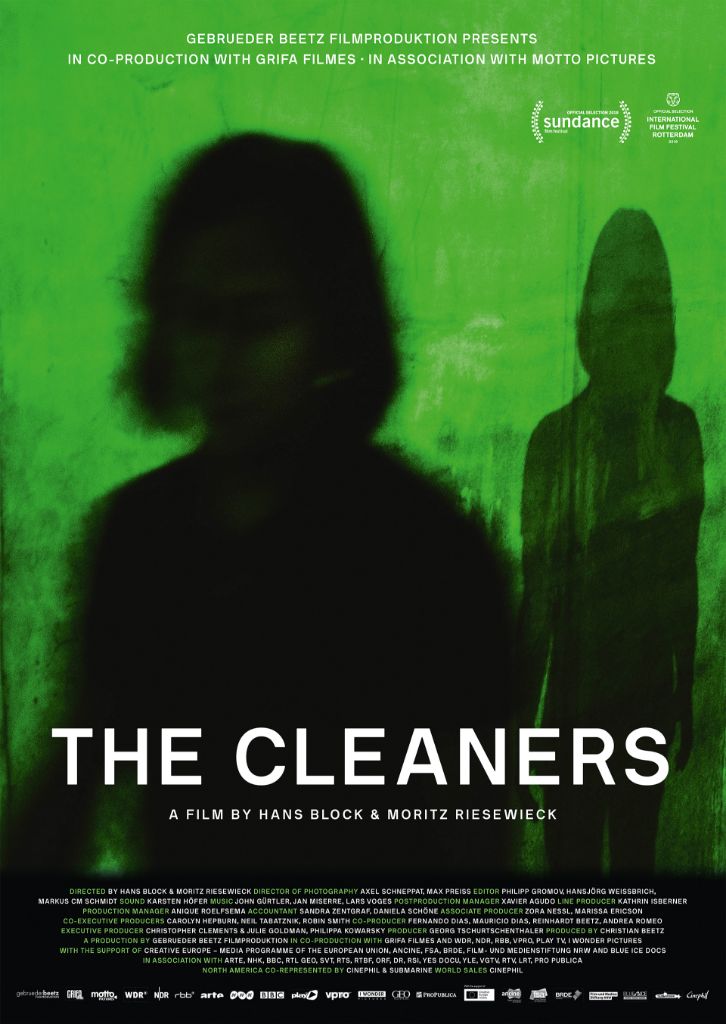
The Cleaners
Five Manila moderators reveal the human judgments and outsourced risks behind platforms’ apparently automated public spaces.
- Director
- Hans Block; Moritz Riesewieck
- Year
- 2018
- Region
- Brazil / Germany
- Duration
- 88 min · 2018 production press-kit edition
Reading the film
A platform’s clean surface is somebody else’s working day. Hans Block and Moritz Riesewieck’s The Cleaners follows five content moderators in Manila and connects their decisions to the companies and users affected by them. What appears to be an automated public space depends on people repeatedly judging images, violence and political expression. The documentary’s feminist significance lies in this distribution of judgment: workers must interpret the world, while the authority to set rules and allocate the consequences remains elsewhere.
Human judgment behind the interface
The production dossier places the moderators beside former technology executives, artists, researchers and people whose posts were removed. This structure prevents the story from staying inside an outsourcing office. A decision made in Manila can reorganize the visibility of an event elsewhere; a policy written in Silicon Valley becomes an instruction interpreted by a worker under pressure.
Calling this work “cleaning” already contains a judgment. It suggests that unwanted material is dirt and that removal restores an otherwise healthy environment. Yet the work includes deciding whether an image is exploitation, documentation, art, incitement or testimony. The label conceals interpretation precisely where interpretation is indispensable. It also helps companies present the service as a neutral conduit while assigning difficult decisions to contractors.
This division is gendered without requiring every moderator to be a woman. Service labor is expected to absorb emotional harm and keep other people’s environment comfortable, even when the worker’s own conditions receive little attention. A feminist approach asks who receives professional recognition, protection and influence over policy, rather than equating the job’s importance with adequate power for those doing it.
Protection and censorship cannot be reduced to a button
The film’s materials describe artist Illma Gore’s removed anti-Trump image and the work of Airwars with images documenting the Syrian war. These are different contexts, not interchangeable examples of a single innocent image. Their juxtaposition makes a governance problem visible: rules meant to restrict harmful material can also remove evidence or artistic expression, and users may have little understanding of the decision or a route to challenge it.
At the same time, the film addresses the circulation of hatred and violence. The alternative to opaque removal cannot simply be to leave everything online. Exposure, harassment and incitement have consequences for the people represented or targeted. The distributor’s film page offers the documentary as an encounter with both the workers’ conditions and the effects of censorship. The difficulty is to protect people while making rule-setting, context and appeals publicly accountable.
This tension is particularly important for feminist speech. An image of a body can be evidence, self-representation, art or abuse; its meaning depends on consent, circulation and context. A universal “appropriate/inappropriate” switch cannot carry that work alone. Nor should recognition of difficult cases become an excuse to abandon protection against nonconsensual material or organized targeting.
The harm has a workplace
The production notes describe confidentiality, exposure to disturbing images and different relationships workers develop with their jobs. Some experience pride or moral purpose; others question the outsourcing of damaging work. Their differences matter. A worker can value employment and still be placed in conditions that distribute risk unfairly. Professional commitment is not proof of free consent to every demand.
The film’s attention to psychological harm also unsettles the idea that digital work is immaterial. Images remain in memory after a shift ends, and contractual silence may obstruct support. The question is not whether certain workers are naturally resilient enough, but who determines workloads, provides care and bears responsibility when the work injures people. A platform cannot outsource those obligations merely by outsourcing the task.
There is an uncomfortable representational question as well. The directors’ descriptions sometimes frame workers’ decisions through religious morality. That can illuminate a particular person’s account, but it should not become an explanation of Philippine workers or Catholic culture as a whole. Corporate policy, training, employment insecurity and time pressure cannot disappear behind a story about individual belief.
Make the institution visible too
The film is a 2018 intervention, not a live audit of every platform today. Its five moderators do not represent an entire workforce, and the geographic movement of the argument can compress differences among countries and political conflicts. Keeping those limits visible makes the documentary more useful: it opens questions about a system without becoming exhaustive evidence for each of its effects.
The practical consequence is to connect workers’ rights with users’ rights. Better appeal procedures, contextual decisions and transparency need labor conditions that permit careful judgment. Conversely, making moderation more comfortable for workers does not by itself give users or targeted communities authority over the rules. Workplace protection and democratic accountability support each other but are not identical achievements.
Read the film with Sarah T. Roberts’s Behind the Screen for a fuller analysis of commercial moderation’s labor arrangements, and with the Feminist Principles of the Internet for questions of participation, expression and consent. Coded Bias offers a contrasting route through algorithmic evaluation. Together they ask who performs judgment, who governs it and who can refuse the costs hidden behind a frictionless interface.


Reader responses
Discussion
Share your response and continue the reading together.
Join the Discussion
Loading comments...
Support Us
If you find our content valuable, please consider supporting FemRes.