Data Feminism · Books
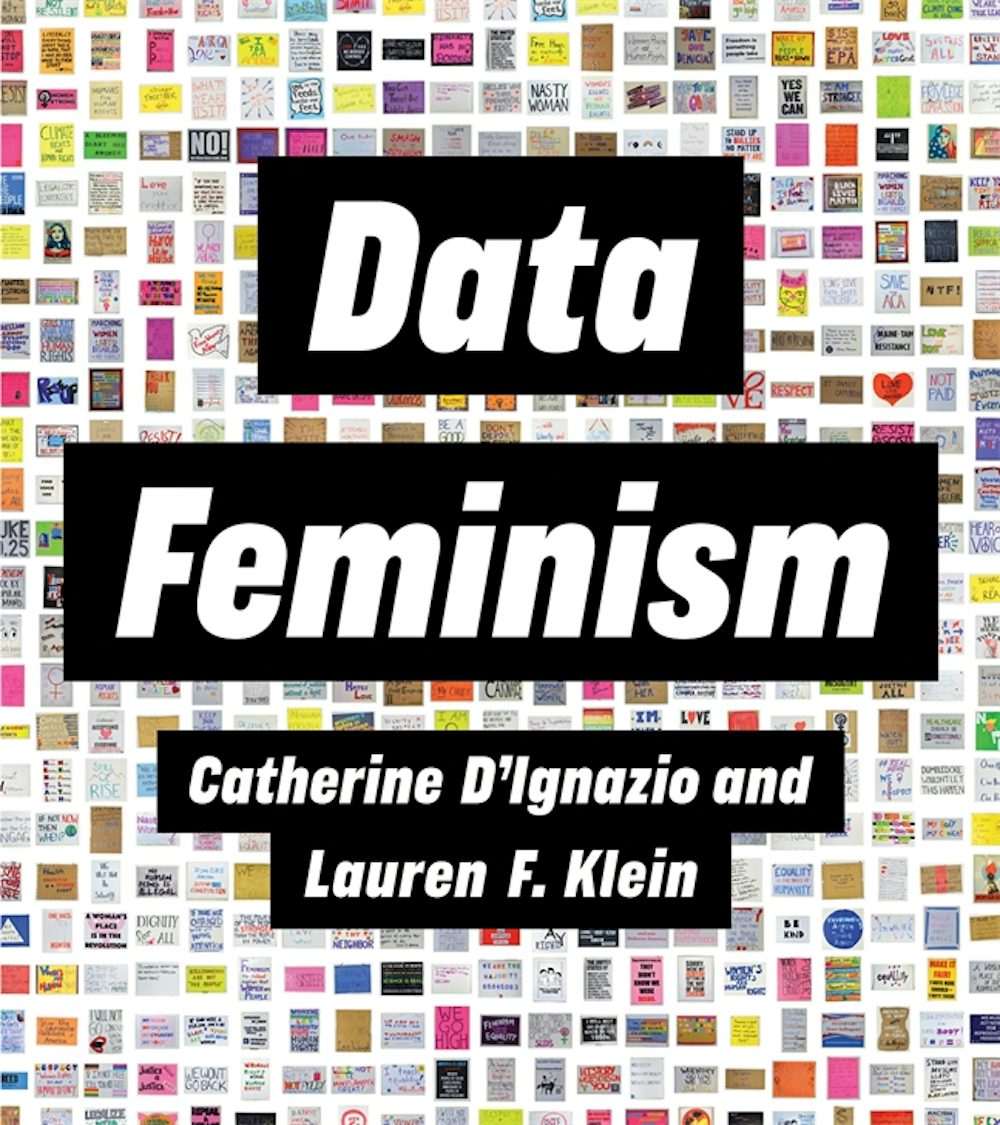
Data Feminism
It proposes seven practical principles that bring power analysis, intersectionality, situated knowledge, and co-design into data work itself.
Review and reading guide
Data Feminism is not a manual for adding a “gender perspective” to an otherwise finished algorithm. It is a political methodology for examining who has the power to produce knowledge. Catherine D’Ignazio and Lauren F. Klein begin from intersectional feminism and reject the idea that data are natural facts waiting to be uncovered. From the initial question and the categories chosen to sampling, cleaning, visualization, and publication, every stage contains judgments shaped by funding, institutional authority, and divisions of labor. The important question is therefore not only why a model is biased, but who was authorized to define reality, measure other people, and decide which harms deserve to count.
The book organizes this argument through seven interlocking principles: examine power, challenge power, elevate emotion and embodiment, rethink binaries and hierarchies, embrace pluralism, consider context, and make labor visible. These are not seven optional ethical decorations. Without examining who controls an infrastructure, “participatory design” can amount to little more than consultation. Without questioning categories such as male/female, normal/abnormal, or legal/illegal, even an accurate model may harden an unjust institution. Without documenting how and by whom data were collected, transparency can reveal an output while concealing its conditions of production.
The published introduction grounds this approach in Christine Darden’s career at NASA and Gloria Champine’s evidence about unequal promotion. Darden already knew the discrimination through experience. Data did not grant legitimacy to her feelings; they helped make an institutional distribution of rank answerable. Asking why people with comparable accomplishments entered different career tracks goes further than encouraging women to become more confident.
Chapter two contrasts community mapping in Detroit with residential redlining maps. Black young people led by Gwendolyn Warren collaborated with academic geographers to map dangers facing children. Banks and communities can use similar visual techniques to define very different risks. The political distinction concerns the question a map serves and who leads its production, rather than a supposedly objective appearance.
One of the book’s most consequential moves is to treat people situated below institutional power as co-producers of knowledge rather than research subjects. Communities that document femicide, eviction, environmental harm, or experiences that official systems refuse to count are not simply filling gaps in state databases. They are contesting who names the problem, who owns the evidence, and whose timetable guides action. Seen this way, a lack of data can indicate institutional neglect, but invisibility can also be a form of protection from surveillance. Data justice does not mean collecting everything; it requires political judgment about accountability, exposure, consent, and the right not to be captured.
D’Ignazio and Klein’s defense of emotion and embodiment also corrects a long history in which women and marginalized people were excluded from “objective” knowledge. Anger, grief, fear, and experiences of care are not necessarily noise contaminating analysis; they may reveal injuries that a variable has failed to represent. Their discussion of visualization makes the same point in another form. A chart does more than transmit quantities: it establishes distance, directs attention, and organizes the conditions under which viewers may feel or refuse empathy. Acknowledging embodiment does not abandon evidence. It recognizes that evidence is always interpreted by people who occupy positions, bear risks, and live with the consequences.
The principle of making labor visible carries the critique into the material foundations of the data economy. Systems described as automated depend on data-entry workers, content moderators, annotators, translators, community intermediaries, maintainers, and people repeatedly required to document their own deprivation. Conventional accounts concentrate credit in the model, laboratory, or founder while leaving maintenance, correction, and traumatic labor outside the story of innovation. Here data feminism meets theories of social reproduction: only after identifying who sustains a system can we ask who should receive resources, authorship, decision-making power, and the right to refuse harmful work.
Another major contribution is the refusal to reduce feminism to “data about women.” Drawing on Black feminist thought, postcolonial theory, queer scholarship, and Indigenous knowledge traditions, the authors show that gender must be analyzed together with race, class, disability, colonial history, and geography. The book’s open-access publication and community-review process also attempt to enact its claim that knowledge is partial and should remain open to revision by multiple perspectives. That combination makes it unusually useful across fields: it criticizes data science while still offering a vocabulary for changing research, journalism, design, public policy, and organizing.
The seven principles nevertheless carry a risk of institutional domestication. An organization can hold a co-design workshop, add more identity fields, or publish a model card without transferring budget or decision-making power. Many examples emerge from North American academic, nonprofit, and civic-technology settings and must be reinterpreted where state violence is more intense, data infrastructure is thinner, or platform labor is outsourced across borders. Nor can a methodological framework by itself change commercial secrecy, intellectual-property rules, or performance incentives that reward rapid deployment. The book can open a power analysis, but it cannot substitute for unions, regulation, public investment, or community ownership.
Data Feminism works best as a reusable audit framework. When encountering health statistics, hiring systems, generative AI, welfare eligibility, or predictive policing, ask not only whether a model is accurate. Ask who posed the problem, whom a classification harms, whether absence means silencing or refusal, whose labor repairs errors, and whether affected people can veto the system. Read alongside work on algorithmic oppression, design justice, platform labor, and feminist epistemology, the book offers no frictionless technological solution. It makes a harder and more honest demand: if data practice leaves power relations intact, “fairness” may become only a more sophisticated interface for the same authority.


Reader responses
Readers' notes
Share your reading or add a thread worth following further.
Join the Discussion
Loading comments...
Support Us
If you find our content valuable, please consider supporting FemRes.