Latin American Feminism · Books
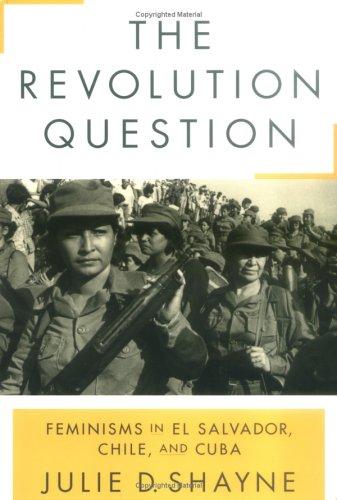
The Revolution Question
Feminisms in El Salvador, Chile, and Cuba
A comparative study asking what women contribute to revolutions—and what revolutionary movements, victories, defeats, and transitions subsequently do to women and feminist politics.
Review and reading guide
Julie D. Shayne organizes the book around a double question: what do women do for revolutions, and what do revolutions do for women? The publisher’s contents set out three distinct timelines: revolutionary struggle and postwar feminism in El Salvador (1979–99); Allende’s government, Pinochet’s dictatorship, and subsequent democratization in Chile (1970–99); and Cuba’s insurrection and the women’s movement after it (1952–99). This structure makes political transitions—not a universal heroic image of “the revolutionary woman”—the basis of comparison.
Shayne draws on in-depth interviews with activists in all three countries and compares women’s participation in armed and unarmed political activity. She argues that women’s contributions are often treated as less important than those of male comrades even when they help movements expand. The study is not a single inventory of tasks shared by women in every case: it asks how participation takes shape within different organizations and historical circumstances, and why some kinds of political work disappear from movement histories.
Shayne is not arguing that taking part in a revolution automatically makes someone a feminist. Rather, revolutionary experience can contribute to a feminist agenda when political and ideological conditions allow it. Struggle and organizing may create skills and connections, while movement leaders can still subordinate gender claims to unity or other priorities; peace accords, democratization, and the consolidation of a revolutionary state then produce different conditions for women’s movements. The chapters invite comparison across those transitions instead of treating any single outcome as inevitable.
Shayne’s comparative method is especially useful because it refuses the easy claim that left politics automatically delivers gender justice. Class struggle, anti-imperialism, and national liberation can expand women’s political agency, but they do not dissolve domestic labor, sexual hierarchy, or organizational sexism. Feminism emerges both inside revolutionary projects and against their limits.
Published in 2004, the study’s historical scope largely ends in the late 1990s; it cannot substitute for research on later feminist strikes, digital organizing, or contemporary anti-rights politics. It is best read as a historical comparison and a set of questions for evaluating emancipatory projects: whose labor sustains them, whose demands are postponed, and who can shape the movement after political transition? See the Rutgers University Press description and contents for the book’s chapter timelines and interview-based method.

Feminisms in Movement
Lívia De Souza Lima, Edith Otero Quezada, Julia Roth

Feminism for the Americas
Katherine M. Marino

Women and Social Movements in Latin America
Women and Social Movements in Latin America: Power from BelowLynn Stephen

The Women's Movement in Latin America
Jane S. Jaquette
Explore another medium
- Articles
I Speak for My Difference
Pedro Lemebel
Pedro Lemebel’s 1986 manifesto confronts the Chilean left with poverty, queer exclusion and revolutionary masculinity, refusing solidarity on condition of self-erasure.
Latin American Feminism · Social Movements - Articles
Women’s Day
Alexandra Kollontai
Kollontai answers fears that organizing specifically among women divides workers, showing why an open organizational door does not itself make participation possible.
Social Movements · Socialist Feminism
Continue through the issues
Reader responses
Readers' notes
Share your reading or add a thread worth following further.
Join the Discussion
Loading comments...
Support Us
If you find our content valuable, please consider supporting FemRes.