Who shapes our digital lives?
A search, a face, a benefits application: each encounters rules deciding who becomes visible and who is excluded. Starting with Data Feminism, this issue follows classification, moderation, prediction and design into everyday life. Who performs the labor behind automation? Which communities are claiming rights to participate, appeal and refuse? Technology’s future also depends on who can change today’s rules.
In this issue
30 items
Books10
Books · Mar 2020
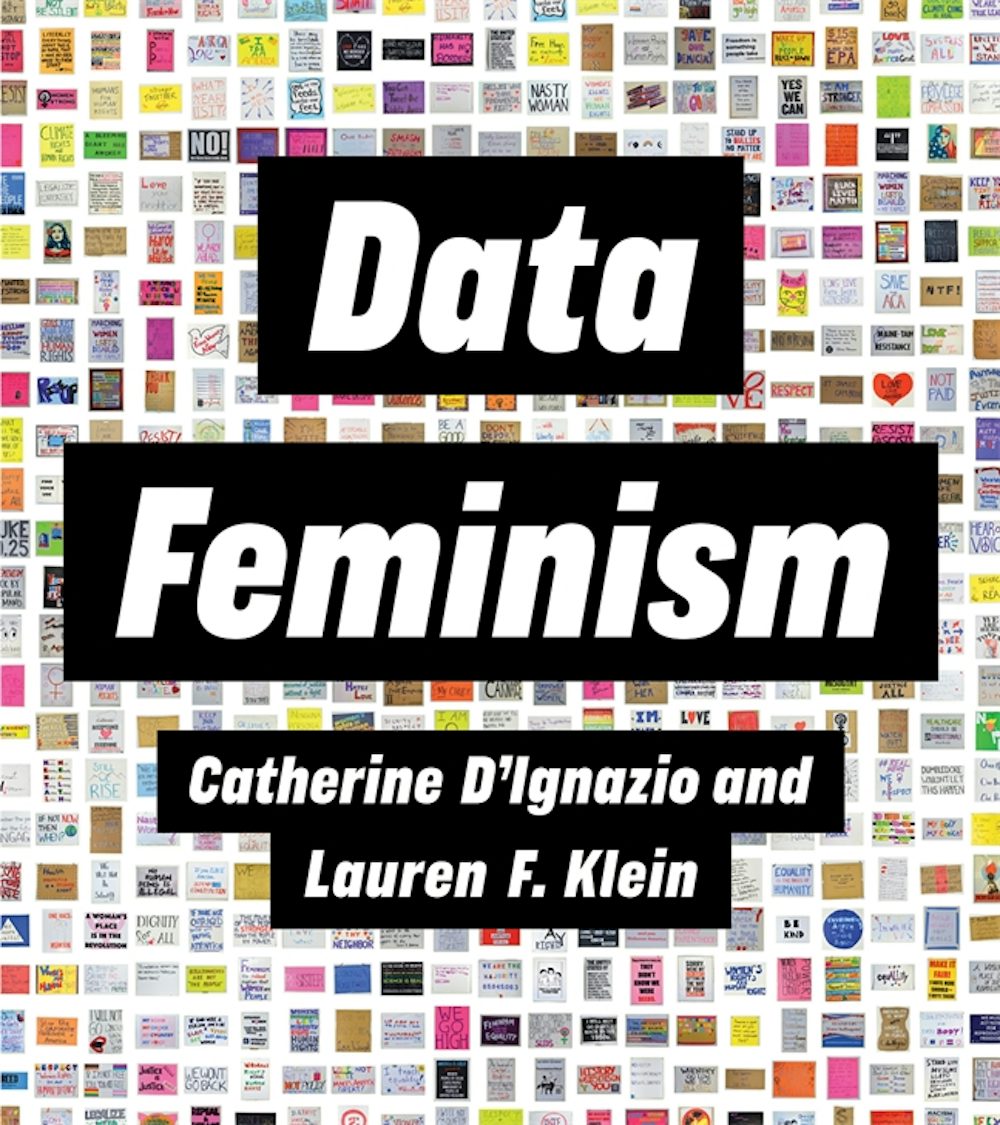
Data Feminism
Catherine D'Ignazio and Lauren F. KleinIt proposes seven practical principles that bring power analysis, intersectionality, situated knowledge, and co-design into data work itself.
02
Books · Feb 2018
Algorithms of Oppression
Safiya Umoja NobleSafiya Umoja Noble begins with the stigmatization of Black girls in commercial search to expose how advertising markets, platform monopoly, and knowledge classification produce algorithmic oppression.
03
Books · Jul 2019
Race After Technology
Ruha BenjaminRuha Benjamin’s New Jim Code framework shows how racial hierarchy can be engineered, hidden by defaults, intensified through surveillance, or repackaged as a benevolent technical fix.
04
Books · Jan 2018
Automating Inequality
Virginia EubanksInvestigating welfare, homeless housing, and child protection, Virginia Eubanks shows how automation disguises austerity as neutral efficiency and subjects poor people to continuous surveillance.
05
Books · Sep 2021
Behind the Screen
Sarah T. RobertsThrough transnational interviews, Sarah T. Roberts reveals commercial content moderation: the automation and safety visible on platforms rely on secret, quantified, and outsourced human judgment.
06
Books · Jan 2017
Programmed Inequality
Programmed Inequality: How Britain Discarded Women Technologists and Lost Its Edge in ComputingMar Hicks (published as Marie Hicks)Mar Hicks traces how British institutions classified women’s computing expertise as low-status labor, then built a prestigious field that excluded the workers on whom it depended.
07
Books · Mar 2020
Design Justice
Sasha Costanza-ChockStarting from trans airport screening and disability justice, Sasha Costanza-Chock argues for design led by affected communities, placing benefit, ownership, and accountability above expert good intentions.
08
Books · Aug 2022
Atlas of AI
Kate CrawfordKate Crawford maps AI through minerals, energy, hidden labor, training data, classification, and state surveillance, revealing the extraction and concentrated power beneath machine intelligence.
09
Books · Sep 2020
Glitch Feminism: A Manifesto
Legacy RussellLegacy Russell reads the glitch as a refusal of gendered and racialized systems of bodily classification, while asking what digital art can open - and what platforms still capture.
10
Books · Apr 2019
How to Do Nothing
Jenny OdellA profound and philosophical guide to reclaiming our attention in an era where our focus is commodified and efficiency is seen as the ultimate value. Odell explores how ‘doing nothing’ can be a radical act of resistance, leading to deeper connections with our local environments, communities, and ourselves.
Films3

Films · Jan 2020
Coded Bias
Shalini KantayyaKantayya follows Buolamwini’s research to connect facial classification, women’s expertise and public control of technology.
02
Films · Jan 2018
The Cleaners
Hans Block; Moritz RiesewieckFive Manila moderators reveal the human judgments and outsourced risks behind platforms’ apparently automated public spaces.
03
Films · Dec 2016
Hidden Figures
Theodore MelfiThe true story of three African-American female mathematicians who played crucial roles in NASA's space race during the 1960s. They not only had to face racial discrimination but also overcome gender bias, ultimately making indelible contributions to America's aerospace program through their exceptional talents.
Videos3

Videos · Mar 2017
How I’m Fighting Bias in Algorithms
Joy BuolamwiniJoy Buolamwini traces algorithmic bias from facial-analysis failures to the institutions that decide what systems see, whom they serve, and who can challenge their use.
02
Videos · Apr 2022
I Saw None, so I Built One: Women in the Tech Community
Aishath AdnanMaldivian technology manager Aishath Adnan reflects on founding Women in Tech Maldives and connects women's visibility in tech to island connectivity, education and care policy.
03
Videos · Jul 2019
Claiming Back the Role of Women in Technology
Melina MasnattaMelina Masnatta traces how gender shapes who is encouraged into technology, from childhood and education to professional workplaces, and asks what institutions can change.
Podcasts1

Articles8
Articles · Jan 2019
Feminist Data Manifest-No
Marika Cifor, Patricia Garcia, and collaboratorsThe Feminist Data Manifest-No pairs refusal with commitment, asking how data attaches to bodies, reproduces inequality and whether people can meaningfully say no.
02Articles · Aug 2016
Feminist Principles of the Internet - Version 2.0
Association for Progressive Communications (APC) and feminist contributorsAPC’s Feminist Principles of the Internet connect access, expression, privacy, consent and governance in one political framework for examining how technology distributes power.
03Articles · Oct 2022
Not My AI: A Feminist Framework to Challenge Public-Sector Algorithmic Decisions
Joana Varon and Paz PeñaThrough Latin American public-service cases, Joana Varon and Paz Peña ask who defines problems and bears the costs when algorithms allocate benefits or predict risk.
04Articles · Oct 2020
Free to Be Online?
Plan InternationalPlan International’s State of the World’s Girls 2020 report documents online harassment among girls and young women aged 15 - 25 and asks platforms, governments and communities to share responsibility.
05Articles · Jun 2022
Women’s Digital Inclusion in Latin America and the Caribbean
Iliana Vaca-Trigo; María Elena ValenzuelaCEPAL connects digital participation to income, care and control over devices, asking why internet access alone cannot secure women’s autonomy.
06Articles · Dec 2018
Troll Patrol: Crowdsourced Evidence of Online Abuse Against Women
Amnesty International & Element AIAmnesty’s Troll Patrol turned crowdsourced Twitter labels into evidence of racialized abuse against women in public life - and offers a case study in the limits of samples, categories and automated inference.
07Articles · May 2023
Online Opposition to Gender Equality
UN Women Asia and the PacificUN Women and Quilt.AI examine anti-feminist narratives in Bangladesh, India and the Philippines, identifying shared tactics and distinct contexts.
08Articles · Apr 2026
Tipping Point: Online Violence Against Women in the Age of AI
Julie Posetti, Kaylee Williams, Lea Hellmueller, Pauline Renaud, Nabeelah Shabbir & Nermine AboulezA UN Women-commissioned 2026 study examines online violence against women human-rights defenders, activists and journalists, including AI-enabled abuse, offline harm and self-censorship.
Papers5
Papers · Feb 2018
Gender Shades: Intersectional Accuracy Disparities in Commercial Gender Classification
Joy Buolamwini; Timnit GebruBuolamwini and Gebru audit commercial gender classifiers, showing how overall accuracy conceals unequal errors across skin-type and gender groups.
02Papers · Oct 2016
Feminist Data Visualization
Catherine D'Ignazio and Lauren F. KleinD’Ignazio and Klein turn feminist epistemology into questions for visualization design: how categories, visual form, participation, context, and labor shape whose knowledge becomes legible.
03Papers · Jun 2024
Data Feminism for AI
Lauren F. Klein and Catherine D'IgnazioKlein and D’Ignazio bring data feminism into AI research, using tenant screening, feminist data activism, and hidden annotation labor to examine power, consent, and environmental costs.
04Papers · Jan 2016
A Future for Intersectional Black Feminist Technology Studies
Safiya Umoja NobleSafiya Umoja Noble connects Black women's representation in search to the extraction, labor, and waste behind digital infrastructure.
05Papers · Jan 1985
A Cyborg Manifesto: Science, Technology, and Socialist-Feminism in the Late Twentieth Century
Donna HarawayThis influential essay reimagines feminist theory through the metaphor of the cyborg - a hybrid of machine and organism. Haraway critiques traditional boundaries between human and non-human, nature and culture, and proposes a post-gender, post-essentialist feminist politics rooted in affinity, irony, and technological embodiment.