
Latin American Feminism · Books
Feminism for the Americas
Katherine M. Marino recovers Latin American feminists as architects of global women’s rights, tracing how leadership and social justice reshaped Pan-American organizing.
Review and reading guide
Katherine M. Marino’s Feminism for the Americas changes the map of international feminism by treating Latin American and Caribbean activists not as recipients of ideas formed elsewhere, but as political thinkers who helped make women’s rights an international question. The University of North Carolina Press’s publisher overview identifies six figures at the center of the book: Bertha Lutz of Brazil, Ofelia Domínguez Navarro of Cuba, Paulina Luisi of Uruguay, Clara González of Panama, Marta Vergara of Chile, and US organizer Doris Stevens. Their interwar networks joined suffrage to equal pay, maternity protections, self-determination, and, increasingly, social and human rights. Marino’s central historical intervention is not simply to add Latin American names to a familiar story; it is to show how the region’s organizers altered the story’s institutions and political terms.
The book refuses to turn “Pan-American feminism” into a harmonious regional sisterhood. Its disagreements begin within Latin America. As Allison B. Wolf recounts in her Hypatia review, Luisi and Lutz disputed who should lead the movement: Spanish-speaking Latin American women, as Luisi argued, or an alliance led by Brazil and the United States, as Lutz favored. González and Domínguez Navarro challenged both US leadership and the assumption that the largest or most powerful Latin American states should speak for the hemisphere. These positions mattered because leadership was not symbolic. It shaped which languages and national experiences counted as universal, which claims reached a conference agenda, and whose political priorities were recognized as feminism.
The Inter-American Commission of Women (IACW), created in 1928, makes that struggle institutional and tangible. Stevens emphasized suffrage and an equal-rights treaty; many Latin American organizers argued that legal equality was too narrow when working women faced economic dependence, state violence, dictatorship, and US imperial power. Wolf’s account of Marino’s chapters describes a material imbalance inside the commission: Stevens guarded leadership appointments and declined to fund Latin American members’ travel, limiting who could participate in the institution whose international authority she helped shape. Read this not as a story reducible to personal rivalry, but as a feminist question about political infrastructure: who can attend, set an agenda, and convert a demand into a treaty?
The response Marino traces as feminismo práctico—practical feminism—expanded the meaning of the work. It connected civil and political rights to social and economic justice, local organizing, and resistance to authoritarianism and imperial intervention. “Practical” here does not mean modest or merely pragmatic. It names a politics tested against the conditions in which women lived and worked. The difference between a treaty on paper and freedom in daily life becomes central: a formal right can matter, but its promise is thin when people cannot organize, earn a living, move safely, or contest state power.
Marta Vergara’s strategy shows that coalition did not require political purity or easy agreement. She helped found Chile’s Movimiento Pro-Emancipación de las Mujeres de Chile (MEMCh) in 1935 and developed a Popular Front feminism that linked women’s claims to antifascism and broader social struggles. Wolf describes Vergara as willing to use alliances with Stevens when they could advance a wider agenda, even after conflict over Stevens’s leadership and the narrowness of treaty politics. This is a more demanding account of solidarity than either unity at any cost or principled separation: organizers made tactical relationships, argued over their terms, and assessed what those alliances could deliver to movements on the ground.
The widening of the agenda is especially visible during the Second World War. Latin American feminists pressed a broad account of human rights that included maternity legislation, labor protections, social and political rights, racial equality, and attention to women’s unemployment after the war. The shift from “women’s rights” to “human rights” could create a larger international vocabulary, but it could also dilute demands for concrete social action. Marino’s history therefore asks readers to notice not only which rights entered official language, but also what was left out when governments and institutions defined the agenda.
At the 1945 San Francisco conference, Latin American feminists helped secure references to equal rights for men and women in the UN Charter’s preamble and purposes, as well as language supporting women’s equal representation in UN bodies. Lutz and her allies also helped establish the Commission on the Status of Women. These were consequential institutional gains, built through years of organizing rather than bestowed at the last moment by benevolent diplomats. Yet the distance between international recognition and enforceable change remains important: a charter can create a standard and a political foothold without ensuring that states honor either. The women who shaped that language were later pushed to the margins of feminism’s dominant histories, a disappearance Marino connects to the politics of historical memory and the Cold War’s suspicion of social-rights agendas.
For contemporary readers, the book’s strongest lesson is that international solidarity must be judged by its structure as well as its declared ideals. Who controls the institution, pays for participation, chooses the working language, and defines a universal claim? The history of the IACW shows how a movement can oppose gender exclusion while reproducing imperial hierarchy within its own organizations. At the same time, the focus on six prominent organizers and formal institutions cannot stand in for every Indigenous, Afro-descendant, rural, or working-class feminist tradition across the hemisphere. That limit makes the book a starting point for further historical work, not a complete census of regional politics.
Read alongside Chandra Talpade Mohanty’s Feminism without Borders, Marino’s history supplies a grounded institutional counterpart to a theoretical question: how can cross-border politics recognize difference without turning it into either a hierarchy or an excuse for separation? Together, the books make solidarity less a feeling than a practice of accountable coalition—one that must keep asking who is able to shape the common agenda and whose material needs it serves.

Feminism without Borders
Chandra Talpade Mohanty

Feminisms in Movement
Lívia De Souza Lima, Edith Otero Quezada, Julia Roth
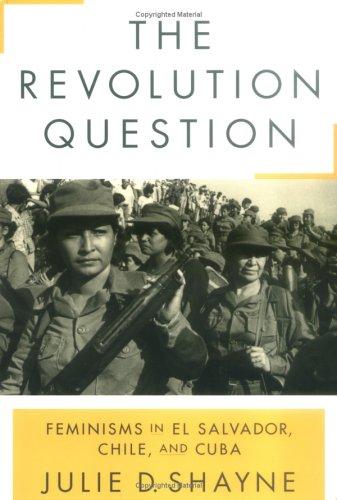
The Revolution Question
Julie D. Shayne

Gender and Sexuality in Latin America
Cristina Motta, Macarena Sáez
Explore another medium
- Articles
Belém do Pará Convention
Organization of American States (OAS)
The 1994 inter-American convention connects public, private and state violence against women to prevention, remedies and due diligence.
Latin American Feminism · Human Rights - Articles
Indigenous Women in Latin America: Demographic and Social Dynamics in a Human-Rights Framework
ECLAC / CELADE / Gender Equality Observatory
A regional evidence base on Indigenous women’s physical, economic, and political autonomy that also exposes how statistical invisibility limits rights, policy, and accountability.
Latin American Feminism · Political Participation
Continue through the issues
Reader responses
Readers' notes
Share your reading or add a thread worth following further.
Join the Discussion
Loading comments...
Support Us
If you find our content valuable, please consider supporting FemRes.