Chicana Feminism · Books
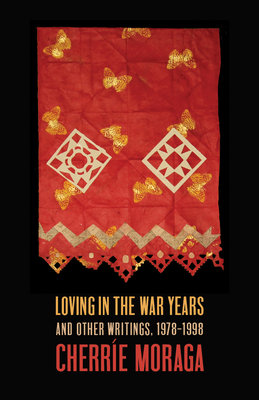
Loving in the War Years
Cherríe Moraga's landmark Chicana lesbian feminist essays and poems examine family, racialized labor, desire, language, and coalition. This reading centers the 1983 original, not every piece in the expanded 2023 edition.
Review and reading guide
The listed 2023 Haymarket edition combines the original memoir with The Last Generation: Poetry and Prose and includes a new introduction by Moraga.
Cherríe Moraga’s Loving in the War Years is not a memoir that moves neatly from injury to self-acceptance. Its essays and poems return to the same intimate scenes—her mother’s labor, the family home, Catholic memory, racial passing, lesbian desire—from changing angles, allowing political understanding to emerge through revision and contradiction. The title’s “war” is not one event: it names the pressure of living inside interlocking struggles over race, class, gender, sexuality, language, and cultural belonging. Love, in this book, is neither an escape from those conflicts nor proof that they have been resolved. It is a demanding relation to people and histories one may also have to criticize.
“La Güera” makes that method especially clear. Moraga begins with an asymmetry between herself and her mother: she is highly educated and light-skinned, while her mother was pulled from school as a child to work in the fields and later performed factory and piecework labor. As a young woman, Moraga helps fill out applications and checks for her mother; the scenes show literacy as both care between generations and a practical response to institutions that have denied the mother access. The daughter’s education is not presented as a simple triumph over poverty. It is a form of mobility made possible alongside the labor and sacrifices of the woman whose stories she carries.
The essay complicates that inheritance further. Moraga describes how her family’s proximity to whiteness could offer conditional protection, while Spanish was not passed on to her and class distinctions were used to distance the family from poorer Mexicans. Her light skin and schooling gave her choices unavailable to darker relatives, but they also trained her to mistake assimilation for safety and to disavow parts of her own history. When she names herself la güera, she does not treat whiteness as a stable identity she either possesses or lacks. She examines it as a privilege she can sometimes use, a value absorbed into family life, and a source of estrangement from people she loves. The essay’s force comes from refusing both innocence and a clean redemption: recognizing privilege does not undo it, and claiming Chicana belonging does not erase the unequal terms on which that belonging was shaped.
Moraga’s lesbianism becomes a point of connection with her mother’s experiences of gendered, racialized, and classed constraint, but not a claim that the two women have suffered in the same way. She presents coming out as a way of recognizing the workings of silence in her own life and, through that recognition, becoming more answerable to forms of oppression she had not experienced firsthand. Her insistence on specificity matters: solidarity cannot be built by ranking injuries, collapsing them into one universal story, or using theory to avoid the emotional work of seeing how privilege and subordination operate in oneself. Yet empathy is not a substitute for material accountability. The essay asks what a person will risk changing once a connection has been made—and whether a movement will remain in relationship when that change is uncomfortable.
“A Long Line of Vendidas” shifts the inquiry into family memory and Chicano political culture. Its account of girls being expected to serve brothers and male visitors shows how gender hierarchy is learned through ordinary domestic labor, not only through explicit doctrine. Moraga sets that expectation beside her mother’s own history of serving men and asks what can be chosen, inherited, refused, or temporarily continued in the name of respect for the women who came before. The remembered scene is not reduced to a simple opposition between a liberated daughter and a traditional mother: the mother’s desires, tenderness, endurance, and constraints remain visible, even as the daughter names the unequal arrangement.
The essay then examines the accusation of vendida—a sellout or traitor—directed at women whose sexual or political choices are treated as betrayals of the community. Moraga reworks the Malinche/La Chingada story as a politically powerful myth through which women are made to bear blame for colonial violence and cultural loss. This is her situated feminist reading of that inheritance, not a neutral or exhaustive account of Mexican history. Her target is the way nationalist narratives can demand women’s loyalty while limiting their agency, and the way lesbian Chicanas can be cast as culturally disloyal for refusing heterosexual gender roles. At the same time, the essay does not offer white feminism as an uncomplicated refuge: its own racial and class exclusions can reproduce the demand that women of color translate themselves into terms legible to others.
Form is part of the argument. The collection moves among essay, memory, poetry, and English-Spanish speech rather than placing experience into a single academic register. In “La Güera,” the remembered sounds and gestures of women speaking in the kitchen expose what the author’s education had taught her to discount; the body, voice, and family story become ways of knowing, not decorative illustrations of a theory already settled elsewhere. These shifts do not make the book’s language automatically inclusive or transparent. They ask readers to notice who is expected to translate, whose speech is treated as knowledge, and what gets lost when a movement insists on one proper political vocabulary.
The book’s vision of coalition is therefore neither harmony nor a checklist of identities. It is a practice of naming unequal positions, examining how the oppressed can also participate in oppression, and remaining present through disagreement without pretending that all differences have disappeared. Moraga’s challenge to Chicano patriarchy and to white feminist racism is most persuasive when read together: neither community nor movement is exempt from criticism simply because it offers a language of liberation. The demand is harder than inclusion. It is to change the habits, loyalties, and distributions of care through which exclusion is reproduced.
Readers today can value this work without treating every formulation as beyond critique. Its arguments are historically situated, and its reflections on identity and political belonging invite discussion rather than deference. That tension is part of the book’s usefulness: it models feminist thought as accountable, unfinished work. Pairing it with Gloria Anzaldúa’s Borderlands/La Frontera can open a conversation about language, border identity, and cultural mixture; reading it alongside This Bridge Called My Back, which Moraga co-edited with Anzaldúa, places its first-person interventions within a wider women-of-color feminist exchange. These are companions, not substitutes for Moraga’s particular voice.


Reader responses
Readers' notes
Share your reading or add a thread worth following further.
Join the Discussion
Loading comments...
Support Us
If you find our content valuable, please consider supporting FemRes.