Digital Feminism · Books
Programmed Inequality
Original titleProgrammed Inequality: How Britain Discarded Women Technologists and Lost Its Edge in Computing
Mar Hicks traces how British institutions classified women’s computing expertise as low-status labor, then built a prestigious field that excluded the workers on whom it depended.
Review and reading guide
In 1959, a woman computer operator trained two newly hired men on systems the British government urgently needed. They were moved into management; she was demoted, despite being praised for her intelligence and aptitude. Mar Hicks opens Programmed Inequality with this reversal because it makes a familiar story—women were absent from computing because they lacked skill or interest—hard to sustain. The question becomes institutional: who was allowed to turn experience into a career, and who was kept in a supposedly temporary support role? Hicks, whose book appeared under the name Marie Hicks, follows that question through Britain’s public computing systems from the 1930s into the late 1970s.
The book first unsettles the idea that computing began when electronic machines arrived. “Computer” had long named a person who performed calculations. Women worked as human computers, used punched-card machines for scientific and administrative tasks, and entered programming and machine operation as those systems developed. At Bletchley Park, women’s technical work formed part of layered intelligence operations: WRNS personnel operated Bombes and programmed Colossus through switches and plugboards. Hicks does not recast them as the machine’s designers; she shows how skilled operation, testing, and the handling of data made the technology consequential. Secrecy later obscured those roles, while popular accounts often detached the machine from the workers who made it run.
That wartime expertise did not automatically yield secure postwar careers. The Civil Service’s machine grades institutionalized a lower occupational track for data-processing workers. Hicks connects that classification to a wider state strategy: automation promised efficiency, while women’s lower pay was treated as a way to contain labor costs. “Deskilling” here does not mean that the work was actually simple. It describes how employers and official categories represented specialized work as routine, limiting its pay, authority, and prospects. Equal-pay campaigning therefore mattered not only as an individual wage issue; it challenged the state’s ability to build new technical systems on a workforce it deliberately kept cheap and replaceable.
The most revealing shift comes when computing becomes more prestigious. In the 1950s and early 1960s, employers still recruited women into essential roles and trained newcomers on the job. A 1965 Post Office advertisement that drew Cathy Gillespie and Ann Sayce promised to teach applicants with no prior computer experience. Both women found the work exciting, but the Civil Service offered few paths to promotion while remaining in computing. They left for an installation where they could advance and work with IBM machines. Their story makes the “pipeline” explanation look incomplete: the problem was not simply getting women through the door, but whether institutions converted their demonstrated competence into authority and a durable career.
Hicks also reads advertisements, job titles, pay scales, training policies, and bureaucratic reports as part of computing’s history—not as decorative context around an inevitable technical evolution. As women operators became more visible in marketing, they could be presented as the efficient labor that made a system profitable, while their own expertise remained low-status. Later, a new executive track offered better prospects to workers coded as managers and technocrats, while machine operators and programmers remained separated into narrower classes. The field’s “professionalization” was thus not a neutral measurement of newly difficult work. It reorganized who could claim technical authority, often elevating men who lacked the experience already held by women.
The national story is not a simple claim that discrimination alone destroyed British computing. The book also follows austerity, economic competition, shifting computer markets, government centralization, and the state’s choices about supporting domestic firms such as ICL. Its argument is that gendered labor policy contributed to a contrived shortage of skilled workers and to institutions unable to make good use of the people they had trained. The contradiction is striking: a government could invest in advanced machines and ambitious plans for a data-driven state while weakening its technical capacity through its own employment hierarchy. Reading the subtitle as a single-cause explanation would flatten the historical mechanisms Hicks documents; the force of the case lies in how gender discrimination interacted with management and industrial policy.
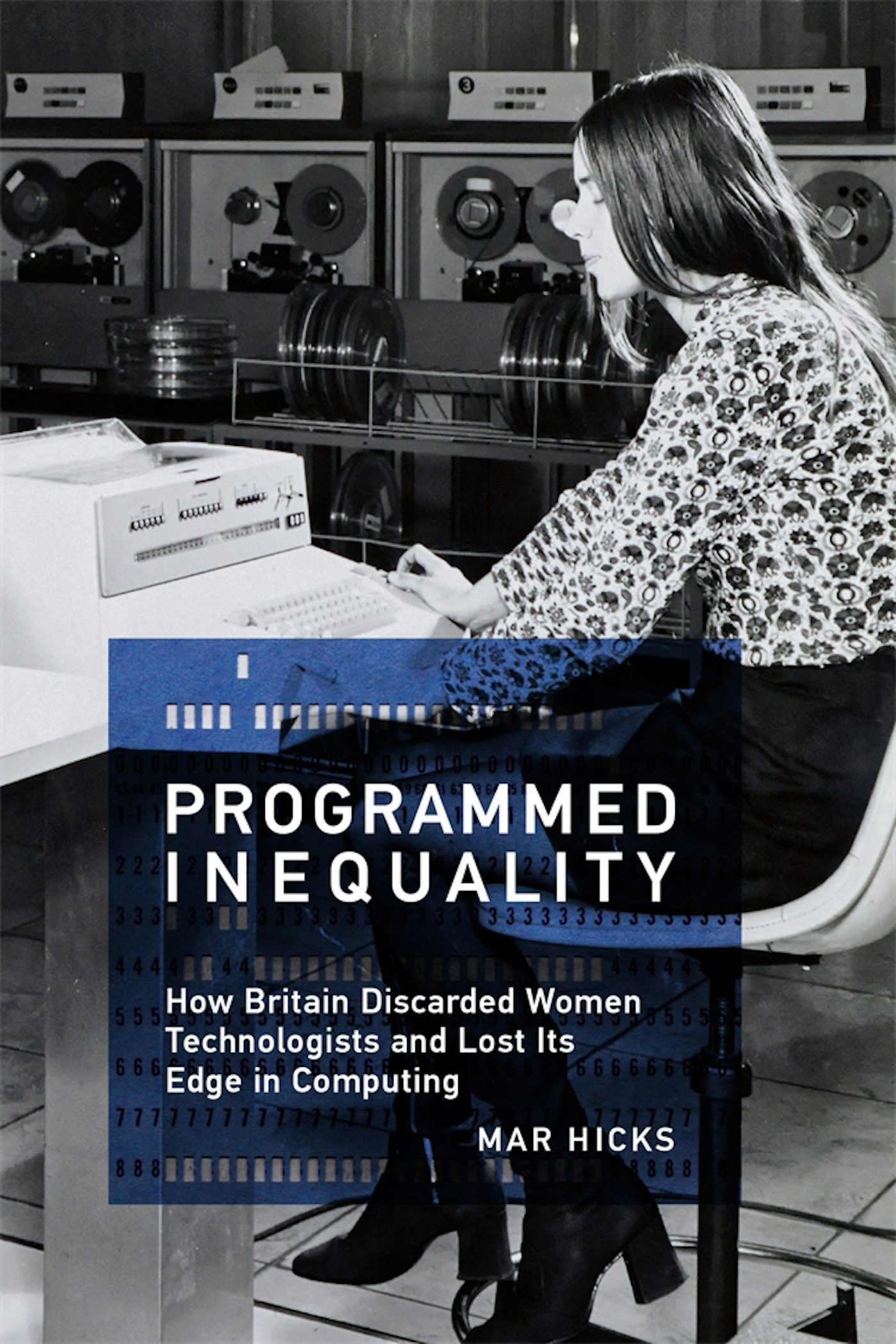
The archive itself is part of this argument. In an essay about the photograph used on the book cover, Hicks explains that images of women at computers often omitted their names; she traced Cathy Gillespie through a distinctive job advertisement and later interviewed her and her former colleague Ann Sayce. The book moves between government files, company records, contemporary media, and oral histories, showing both what an archive can recover and what institutional record-keeping has made difficult to know. Women’s absence from canonical histories is not evidence of their absence from the work. It can be an outcome of how jobs were named, who was photographed as an expert, and whose testimony could be preserved.
For feminist readers, Programmed Inequality is most useful as a study of how occupational status is made. It asks us to look beyond representation and recruitment toward job design, pay, promotion, training, and control over the systems workers maintain. Its close focus is British public-sector computing and the domestic industry around it; it is not a global history of computing labor, and its national case cannot stand in for other colonial, racialized, or transnational histories. Read it alongside Claire L. Evans’s Broad Band to compare women’s roles across a different, largely U.S.- and internet-centered history, or with Your Computer Is on Fire to widen the frame to colonialism, environment, and contemporary infrastructure.


Explore another medium
- Articles
Women’s Digital Inclusion in Latin America and the Caribbean
Iliana Vaca-Trigo; María Elena Valenzuela
CEPAL connects digital participation to income, care and control over devices, asking why internet access alone cannot secure women’s autonomy.
Digital Feminism · Technology Critique - Videos
Claiming Back the Role of Women in Technology
Melina Masnatta
Melina Masnatta traces how gender shapes who is encouraged into technology, from childhood and education to professional workplaces, and asks what institutions can change.
Digital Feminism · Technology Critique
Continue through the issues
Included in · No. 11
Who shapes our digital lives?
Who shapes digital systems, sustains their labor, and holds the right to participate, appeal and refuse? Thirty resources connect data to power.
Digital Feminism · Technology Critique
Related theme · No. 09
Who is allowed to desire?
Beginning with The Right to Sex, we ask whose desire is treated as natural and whose requires moral permission. Power shapes desire, but desire gives nobody a claim to another person’s body. Attraction, love, solitude and care have no single answer. Across sexual hierarchies, erotic writing, asexuality and situated experiences, we make room for exploration, uncertainty, refusal and a change of mind.
Gender Politics
Reader responses
Readers' notes
Share your reading or add a thread worth following further.
Join the Discussion
Loading comments...
Support Us
If you find our content valuable, please consider supporting FemRes.