Latin American Feminism · Books
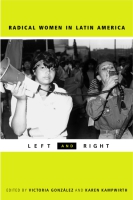
Radical Women in Latin America: Left and Right
A six-country study of women’s organizing across the Latin American left and right, asking how political agency can coexist with sharply different projects and gender orders.
Review and reading guide
Edited by Victoria González-Rivera and Karen Kampwirth, Radical Women in Latin America: Left and Right makes comparison itself a feminist problem. The collection brings women’s political participation on the left and right into the same frame, contesting two assumptions that have distorted political history: that militant action belongs to men, and that women’s participation necessarily advances emancipation. Penn State University Press describes essays spanning Nicaragua, El Salvador, Guatemala, Argentina, Brazil, and Chile, and identifies maternalism, feminism, autonomy, and cross-ideological coalitions as recurring concerns (publisher description and edition record). This is not a claim that these projects were equivalent. It asks what women did within them, what political ends their participation served, and how gender shaped both.
The published contents make that comparison concrete without reducing it to one model of “the political woman”: chapter topics include Somocista women and right-wing politics in Nicaragua; Sandinistas and Contras in armed struggle; a Nicaraguan coalition joining left-wing, right-wing, and radical-feminist women; parenthood and feminist reconstruction in El Salvador; and conservative mobilization in Pinochet’s Chile (publisher description; public contents). These topics invite close attention to the conditions of participation: who sets strategy, which work is treated as politically valuable, and whether women can define an agenda beyond the roles of fighter, mother, believer, or supporter.
This framework helps distinguish agency from endorsement. Women can acquire organizing experience, networks, and public authority in movements whose goals remain hierarchical or authoritarian; recognizing that agency must not soften the harm such projects inflict. A feminist reading asks how maternal duty, respectability, sacrifice, and domestic work shape participation—and who gets to set the movement’s aims.
The 2001 anthology is a historically situated set of cases, not a complete map of Latin American women’s politics. A later Oxford Handbook overview stresses the region’s internal differences and the challenges Indigenous, Afro-descendant, lesbian, and trans movements have posed to claims of inclusion (regional context). For a different route into revolutionary participation and its aftermath, continue with The Revolution Question; for a wider history of organizing and democratization, see Women’s Activism in Latin America and the Caribbean. Penn State University Press’s description and the published contents provide the collection’s scope and case map. These pairings are complementary, not claims of influence.


Reader responses
Readers' notes
Share your reading or add a thread worth following further.
Join the Discussion
Loading comments...
Support Us
If you find our content valuable, please consider supporting FemRes.