
Disability Justice · Books
Year of the Tiger
Original titleYear of the Tiger: An Activist's Life
A mixed-media memoir of Asian American family, disability, pandemic politics, access, humor, and collective care—asking whose knowledge and futures matter.
Review and reading guide
Year of the Tiger asks what a memoir can be when it refuses the polished arc of overcoming. Alice Wong describes deliberately remaking the form: instead of narrating every stage of a life in chronological order, she places essays beside interviews, photographs, graphics, commissioned art, a high-school transcript, adolescent poems, Chinese-language homework, and even a crossword. Those objects do more than decorate a story. The transcript makes visible the ordinary, imperfect record behind the “model minority” image; the homework and playful fragments let family memory, popular culture, and self-mockery sit beside political argument. The book’s collage becomes a way of making knowledge: a life is not proved by a seamless success narrative but assembled from materials that institutions and conventional memoirs might dismiss as incidental. Wong explains these choices in an interview with NPR; the publisher’s description likewise identifies the book as a scrapbook of original and previously published work, conversations, images, and commissioned art.
That archive is specifically Chinese American, queer, disabled, and shaped by Wong’s own media practice; it is not a universal template for Asian American or disabled life. A chapter about Lunar New Year memories makes food and family ritual part of historical transmission rather than cultural ornament. Sandy Ho’s publisher-hosted discussion guide also draws attention to a letter addressed to Asian American disabled women and girls, and asks how gender roles and women in families shape the inheritance of tradition. Read together, these anchors show identity as lived and negotiated across generations, not a list of demographic labels. The transcript’s resistance to model-minority expectations also matters here: Wong’s account can hold affection for family and cultural memory without turning either into a tidy story of assimilation or success.
The feminist argument sharpens when the book turns from who is seen to what makes a voice possible. In an NPR interview, Wong describes herself as a disabled “cyborg,” reliant on equipment, technology, and electricity. That dependence is not a private detail beside the politics; it exposes the infrastructure hidden by ideals of the self-sufficient citizen. Access involves devices, communication, healthcare, assistance, time, money, and relationships—not simply a doorway or a sympathetic attitude. The discussion guide’s questions on the extra costs disabled people bear to secure access and its chapter on the choreography of care make that material dimension concrete. Care appears through conversations and coordinated relationships, including the practical knowledge of attendants. FemRes reads this as a feminist account of care as skilled, negotiated labor: interdependence is not a failure to achieve independence, but part of how people make a life and a public voice possible. It also leaves institutions answerable for the resources that friendship and mutual aid cannot supply on their own. This makes the memoir a situated entry into disability justice, not an exhaustive definition of the movement.
The pandemic sections turn personal memory into a counter-archive of whose danger counts. Wong told NPR that she began the memoir during COVID-19 and understood the urgency of documenting a life amid repeated medical emergencies and the devaluation of disabled people. The discussion guide points to a high-risk timeline and a chapter built from messages and other media traces. Rather than treating a timeline as neutral background, the book’s form invites readers to see how public decisions enter a body and a household—and how disabled people were already building strategies of online connection, mutual aid, and advocacy. Wong’s self-description as a disabled oracle can be read as a challenge to the hierarchy that treats disabled people as objects of prognosis while discounting their analysis of the systems shaping their lives. The point is not that one memoir can document every pandemic experience; it is that this situated record contests the assumption that vulnerability makes someone politically passive or epistemically unreliable.
Humor, food, cats, science fiction, and pleasure keep the book from turning disability into a catalogue of injuries. Wong says speculative fiction matters to her partly because people who feel different or alien can find room in it, and because the genre carries political commentary. The publisher’s guide follows that thread through the book’s imaginative futures, while also making space for anger, rest, care, and joy. This mix is politically important: disabled life is not valuable only when it supplies a lesson, an advocacy campaign, or evidence of suffering. Play and desire are part of what access is for. The book’s wit does not soften its critique; it refuses the demand that a disabled writer be solemn, grateful, and endlessly available to educate others.
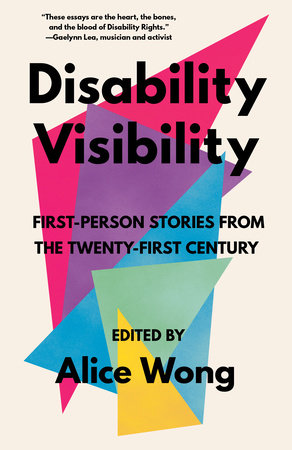
The limit of a memoir is also its ethical question. Wong offers one particular Chinese American, queer, disabled life, carefully assembled through her own selection and editing; no individual voice can stand in for a heterogeneous community. The book’s conversations, commissioned work, and attention to other disabled people complicate solitary authorship, but a curated archive still has boundaries. The Disability Visibility Project page also links to Kelsie Acton’s plain-language summary and Sandy Ho’s discussion guide, useful routes for readers who want different ways into the material. For further reading, place this singular, formally playful self-portrait beside Wong’s Disability Visibility, a multi-author anthology, and Leah Lakshmi Piepzna-Samarasinha’s Care Work, which develops collective access and care through movement writing. These are complementary routes, not claims of direct influence. Year of the Tiger makes visibility answerable to infrastructure: who can leave an archive, whose knowledge is preserved, what labor supports a voice, and who is permitted to imagine a future?
Sources: the publisher’s book record, the Disability Visibility Project book page, Sandy Ho’s discussion guide hosted by the publisher, and NPR’s interview with Alice Wong.
Disability Visibility
Alice Wong

Care Work: Dreaming Disability Justice
Leah Lakshmi Piepzna-Samarasinha

The Future Is Disabled
The Future Is Disabled: Prophecies, Love Notes and Mourning SongsLeah Lakshmi Piepzna-Samarasinha

Feminist Disability Studies
Kim Q. Hall
Explore another medium
- Videos
I Got 99 Problems... Palsy Is Just One
Maysoon Zayid
Maysoon Zayid uses comedy to show how Palestinian, Muslim, female, and disabled identities intersect while challenging ableism in entertainment and public culture.
Disability Justice · Race and Gender - Videos
I'm Not Your Inspiration, Thank You Very Much
Stella Young
In this TEDxSydney talk, Stella Young critiques inspiration porn and the way nondisabled society consumes disabled people as objects of moral uplift.
Disability Justice · Media Representation Critique
Continue through the issues
Related theme · No. 03
Who gets to define the body?
From discipline and ageing to the internalised gaze, this issue follows the forces that watch, name and reclaim the body.
Body Politics
Related theme · No. 07
Why must she be likeable?
Beginning with Unlikeable Female Characters, we revisit women who are angry, desirous, and unwilling to comply. Who sets the terms of likability—and when does rebellion reproduce someone else’s oppression?
Media Representation Critique
Reader responses
Readers' notes
Share your reading or add a thread worth following further.
Join the Discussion
Loading comments...
Support Us
If you find our content valuable, please consider supporting FemRes.