Media index
Prison AbolitionBooks
- 18
- items

Books · Nov 2022
The Trauma of Caste
Thenmozhi SoundararajanThenmozhi Soundararajan combines memoir, Dalit feminism, engaged Buddhism, and embodied practice to examine how caste injury enters bodies, communities, and transnational institutions.
02
Books · Sep 2022
The Transgender Issue
Shon FayeShon Faye places trans politics in Britain within healthcare, housing, labor, class, and punitive systems, making material life central to trans justice.
03
Books · Aug 2022
No More Police: A Case for Abolition
Mariame Kaba, Andrea J. RitchieNo More Police reframes safety by taking it out of punishment infrastructure and into care, survivor support, and social redesign, advancing abolitionist feminist and transformative justice frameworks.
04
Books · Jan 2022
Abolition. Feminism. Now.
Angela Y. Davis, Gina Dent, Erica R. Meiners, Beth E. RichieThis collaborative work traces abolition feminism through women-of-color, queer, anti-capitalist, internationalist movement histories.
05
Books · Feb 2021
We Do This ’Til We Free Us
Mariame KabaMariame Kaba’s essays and interviews connect abolitionist organizing with the collective work of building conditions for safety and freedom.
06
Books · Jul 2020
Prison by Any Other Name
Maya Schenwar, Victoria LawMaya Schenwar and Victoria Law show how electronic monitoring, house arrest, and mandated treatment can expand punishment beyond prison walls.
07
Books · May 2020
Decarcerating Disability
Liat Ben-MosheLiat Ben-Moshe connects deinstitutionalization with prison abolition, challenging the claim that closing institutions caused mass incarceration.
08
Books · Mar 2019
Until We Reckon
Danielle SeredDanielle Sered explores responses to serious violence that center survivors’ needs, require accountability, and pursue repair beyond prison.
09
Books · Mar 2019
All Our Trials
Emily L. ThumaEmily L. Thuma reconstructs the anticarceral politics developed from the 1970s into the early 1980s by criminalized women and Black, queer, prisoner, and psychiatric-survivor organizers.
10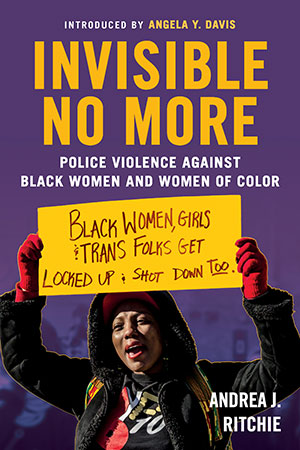
Books · Aug 2017
Invisible No More
Andrea J. RitchieAndrea Ritchie documents police violence against Black women, Indigenous women, immigrant women, sex workers, and trans women whose experiences are often erased from public narratives.
11
Books · May 2017
Becoming Ms. Burton
Susan Burton, Cari LynnSusan Burton’s lived account connects trauma, the drug war, repeated incarceration, and reentry, then turns recovery into care and political work led by formerly incarcerated women.
12
Books · Aug 2016
Color of Violence: The INCITE! Anthology
INCITE! Women of Color Against ViolenceINCITE! centers women of color to connect interpersonal violence with policing, colonialism, militarism, and reproductive control.
13
Books · Sep 2015
Captive Genders
Eric A. Stanley, Nat SmithTrans and queer accounts expose how policing and prisons enforce gender binaries, linking gender liberation with prison abolition.
14
Books · May 2012
Arrested Justice
Beth E. RichieBeth E. Richie examines violence against Black women and how racialized policing and punitive policy undermine their protection.
15
Books · Jan 2011
Queer (In)Justice
Joey L. Mogul, Andrea J. Ritchie, Kay WhitlockThe authors trace how queer criminal stereotypes shape policing, courts, and prisons, turning sexuality and gender expression into suspicion.
16
Books · Jan 2010
The New Jim Crow
Michelle AlexanderMichelle Alexander argues that the War on Drugs and mass incarceration rebuild racial caste through formally colorblind law.
17
Books · Jan 2007
Golden Gulag
Ruth Wilson GilmoreRuth Wilson Gilmore traces California’s prison expansion through the political economy of surplus land, labor, capital, and state capacity.
18
Books · Aug 2003
Are Prisons Obsolete?
Angela Y. DavisAngela Y. Davis’s classic short book denaturalizes prisons as historical institutions and asks readers to imagine justice and safety beyond incarceration.