Socialist Feminism
Explore curated feminist content about Socialist Feminism
- 016
- 16 items
- 06
- Connection paths
Connection paths
Adjacent topics
Media composition
Read along this issue
16 · Socialist Feminism
Books

Books · May 2021
Transgender Marxism
Jules Joanne Gleeson and Elle O'RourkeFourteen essays ask how trans life reshapes Marxist accounts of work, transition, care, class, and social reproduction - and where this deliberately diverse anthology leaves its questions unresolved.
02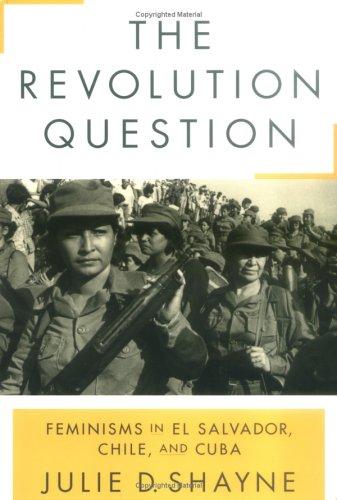
Books · Aug 2004
The Revolution Question
Julie D. ShayneJulie D. Shayne interviews activists in El Salvador, Chile, and Cuba to ask how women sustained revolutionary struggles and who gained the power to set an agenda afterward. Organizational histories, a movement newspaper, and a family code give readers three ways into the comparison.
03
Books · Jan 1996
Sex and Revolution: Women in Socialist Cuba
Lois M. Smith and Alfred PadulaLois M. Smith and Alfred Padula trace how Cuba’s revolution changed women’s education, health, work and family life - and why state-backed equality did not end patriarchy or unpaid care.
Podcasts

Articles
View allArticles · Jan 1986
I Speak for My Difference
Pedro LemebelPedro Lemebel’s 1986 manifesto confronts the Chilean left with poverty, queer exclusion and revolutionary masculinity, refusing solidarity on condition of self-erasure.
02Articles · Mar 1942
Thoughts on March 8
Ding LingDing Ling connects marriage gossip, childcare and judgments of women’s progress in Yan’an, asking who bears responsibility when demands for self-reliance meet exhaustion.
03Articles · Jan 1923
Make Way for Winged Eros
Alexandra KollontaiKollontai opposes possession in love while making intimacy answer to collective duty. Who defines love’s obligations after the old morality loses authority?
04Articles · Jan 1920
Communism and the Family
Alexandra KollontaiKollontai connects freedom in intimate life to kitchens, laundries and childcare, asking who does domestic work and what collective provision must change.
05Articles · Mar 1914
The Proletarian Woman
Rosa LuxemburgLuxemburg connects political participation to wage labor, migration and colonial exploitation, while leaving tensions over unpaid care and the measure of social contribution.
06Articles · Jan 1913
Women’s Day
Alexandra KollontaiKollontai answers fears that organizing specifically among women divides workers, showing why an open organizational door does not itself make participation possible.
Papers
Papers · Feb 2024
From wages for housework to self-care: feminist perspectives on the care economy
Anna MoserAnna Moser places Wages for Housework and the contemporary self-care industry in one political-economic history, showing how capitalism privatizes reproduction and resells individual solutions.
02Papers · Jan 1985
A Cyborg Manifesto: Science, Technology, and Socialist-Feminism in the Late Twentieth Century
Donna HarawayThis influential essay reimagines feminist theory through the metaphor of the cyborg - a hybrid of machine and organism. Haraway critiques traditional boundaries between human and non-human, nature and culture, and proposes a post-gender, post-essentialist feminist politics rooted in affinity, irony, and technological embodiment.
03Papers · Jan 1984
The Master's Tools Will Never Dismantle the Master's House
Audre LordeThis influential essay critiques exclusionary practices within the feminist movement, arguing that using the tools and methods of oppressive systems to fight oppression is doomed to fail. Lorde calls for recognizing and embracing difference as a source of strength, emphasizing that true liberation requires creating entirely new frameworks rather than seeking reform within existing power structures.
04Papers · Jan 1975
Wages Against Housework
Silvia FedericiThis classic Marxist feminist text reveals the truth of housework as central to capitalist relations of production. Federici argues that by naturalizing housework as women's 'labor of love,' capitalism obtains massive amounts of unpaid labor. Demanding wages for housework is not about institutionalizing this labor but about politicizing it, exposing capitalism's exploitation of women's labor.