Migration · Books
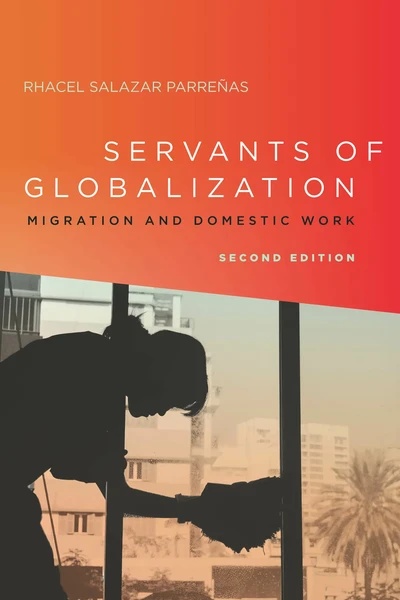
Servants of Globalization
Migration and Domestic Work
Centered on migrant Filipino domestic workers, Parreñas develops the international division of reproductive labor and offers a foundational account of global care chains, transnational families, and migrant women's labor.
Review and reading guide
First published in 2001, Servants of Globalization established Rhacel Salazar Parreñas as a defining analyst of migrant domestic labor. For the second edition, she returned to Rome and Los Angeles to ask what had changed in Filipino migrant communities over more than a decade. Her method joins ethnography to political economy: relations inside a household are not a private footnote to globalization but infrastructure through which affluent societies sustain employment, childrearing, and old age. The two cities are comparative sites rather than interchangeable backdrops, showing how distinct labor markets and immigration regimes produce different degrees of unfreedom.
The book first restores individual migration to an institutional system of labor export. The Philippine economy’s dependence on overseas employment and remittances, stratified visa and residency rules in receiving states, and the power of recruiters and employers together shape direct, serial, and stepwise routes abroad. Domestic workers can carry transnational economic obligations while receiving only incomplete social membership. Parreñas’s account of partial citizenship names globalization’s central contradiction: a society may need migrants’ labor while restricting their ability to change jobs, reunite a family, settle permanently, or claim the protections their work makes possible.
Parreñas’s most influential intervention is the “international division of reproductive labor.” Affluent households delegate cleaning, child care, and elder care to migrant women, while work those migrants once performed is reassigned to relatives, older daughters, or still poorer workers. Care moves through hierarchies of class, nation, race, and legal status; the responsibility does not disappear but lands on people with fewer resources. This makes a global care chain a map of power rather than a sentimental story of mutual help: who can buy another person’s time and intimacy, who must leave home to sell them, and who absorbs the unpaid deficit at the chain’s far end?
Transnational families are the most intimate testing ground for that division. Remittances can improve housing, education, and consumption without erasing the costs of prolonged separation. Long-distance motherhood has to be repeatedly made through calls, gifts, discipline, delegated care, and plans for return. One-parent and two-parent arrangements, as well as later reunification with grown children, show intimacy being strained but also deliberately reconstructed. Parreñas therefore resists blaming the “absent mother”: the sharper feminist question is why care remains defined as women’s natural duty while many women can support their own children only by leaving to care for somebody else’s.
Domestic work also creates what Parreñas calls contradictory class mobility. Migrants may earn more than they could in the Philippines while losing occupational status and control over their time; an employer’s claim that a worker is “like one of the family” can express attachment yet blur overtime, privacy, and contractual limits. Comparing Rome with Los Angeles matters because residency, live-in arrangements, and community resources differ across the two settings. Rising income and downward status can occur together, demonstrating why wages alone cannot tell us whether migration has enlarged a worker’s freedom.
The second edition is especially valuable because it carries the first edition’s gendered account into new stages of life. More children have reunited with parents, more men have entered an occupation coded as women’s work and confront a crisis between breadwinner masculinity and low-status service, and the earliest migrant cohort has grown old. The resulting spectacle of “the elderly caring for the elderly” is not incidental: workers who sustain an employer’s retirement may be unable to retire themselves because benefits are inadequate, earnings would stop, and obligations remain across borders. A care crisis concerns not only who minds children but who cares for carers when they age, become ill, or can no longer sell their labor.
The book’s explanatory power should not turn its cases into a universal map. Rome, Los Angeles, and Filipino migration cannot substitute for the legal histories of the Gulf states, East Asia, or other migrant populations. The care-chain metaphor can also make relations look more linear than they are and inadvertently recode carers as women by default. A field last updated for the 2015 edition needs to be read beside subsequent policy, worker organizing, and first-person accounts. Readers should also keep emotional negotiation within families, state-produced inequality, and an employer’s concrete duties analytically distinct so that structural explanation does not become an excuse for anyone’s conduct.
A productive reading begins by comparing the two cities across five questions: how status is secured, whether work is live-in, whether wages track occupational standing, who controls family reunification, and where retirement protection fails. Then trace one remittance and one act of care through every relative, intermediary, and legal gate they cross. Read alongside migrant domestic-worker organizations, current labor law, and workers’ own writing, the book’s achievement is not to make sacrifice more moving but to prove that apparently private care is publicly allocated. A feminism that expands professional women’s choices without transforming the migrant labor system beneath those choices merely relocates inequality to other women.


Reader responses
Readers' notes
Share your reading or add a thread worth following further.
Join the Discussion
Loading comments...
Support Us
If you find our content valuable, please consider supporting FemRes.